Most B2B marketing teams treat demand generation and lead generation as competing budget items. The demand gen team runs ungated content and brand campaigns. The lead gen team runs gated ebooks and paid acquisition. Each reports to a different metric. Neither talks to the other much.
The result is a pipeline that's either starved of awareness or full of contacts who were never genuinely ready to buy.
The main differences between demand and lead gen
Here's the thing: demand generation and lead generation are not two strategies. They're two sequential stages in the same process. You can't generate qualified leads without first generating sufficient demand. And generating demand without a mechanism to capture it is expensive brand awareness with no path to revenue.
Getting the relationship right — and specifically, understanding where the handoff happens — is what separates programs that produce predictable pipeline from those that produce a lot of activity and very little closed revenue.
This article includes real life examples, using the webinars to drive home the differences between demand gen and lead gen. But first, let's get our understanding straight.
Demand Generation Is Bigger Than Most People Think
Demand generation is the process of creating and sustaining interest in your product or category before a buyer is ready to raise their hand. It covers everything from brand awareness to buyer education to the long game of making sure you're on the shortlist when the purchase moment arrives.
Tactics include content marketing, SEO, social selling, webinars and virtual events, podcasts, community building, and paid reach campaigns. The defining characteristic: you're not asking for anything in return. No forms. No friction. Just value.
Lots of useful demand and lead gen stats
The goal of demand gen is not leads, it's pipeline velocity. You're reducing the time between first exposure and purchase intent by building trust and familiarity ahead of the buying decision. HubSpot's 2026 State of Marketing data shows 34% of marketers name lead generation as their top priority — a figure that reflects how much the downstream step dominates attention, often at the expense of the upstream work that makes it actually work.
Demand gen metrics to track:
Marketing qualified leads (MQLs) entering the funnel
Cost per MQL
Pipeline influenced (multi-touch attribution)
Content engagement — time on page, event attendance, replay views
Brand awareness indicators
Demand generation also covers retention and expansion — customer webinars, onboarding content, thought leadership that keeps existing accounts engaged. It's not purely an acquisition function, which is why the budget case for it extends beyond new logo targets.
Lead generation is the moment demand becomes a name in your CRM. It's the act of converting a person who has shown interest, through behaviour, intent signals, or direct inquiry, into an identifiable contact your sales team can work with.
Gated assets, demo request forms, free trial sign-ups, webinar registrations, contact enrichment and inbound inquiry forms are all lead gen mechanisms. The defining characteristic: something is exchanged. The buyer gives you their information and you give them access or value in return.
Lead generation is sometimes called "demand capture" — and that framing is more accurate than it might seem. You can only capture demand that already exists. Teams that skip the demand gen phase and jump straight to lead gen tactics end up with low-quality contacts, poor conversion rates and sales teams that ignore the MQL queue. The leads exist on paper but they're not actually ready.
Lead gen metrics to track:
Sales qualified leads (SQLs)
MQL-to-SQL conversion rate
Pipeline generated (direct attribution)
Cost per SQL
Lead-to-close rate by source
The core distinction in one line
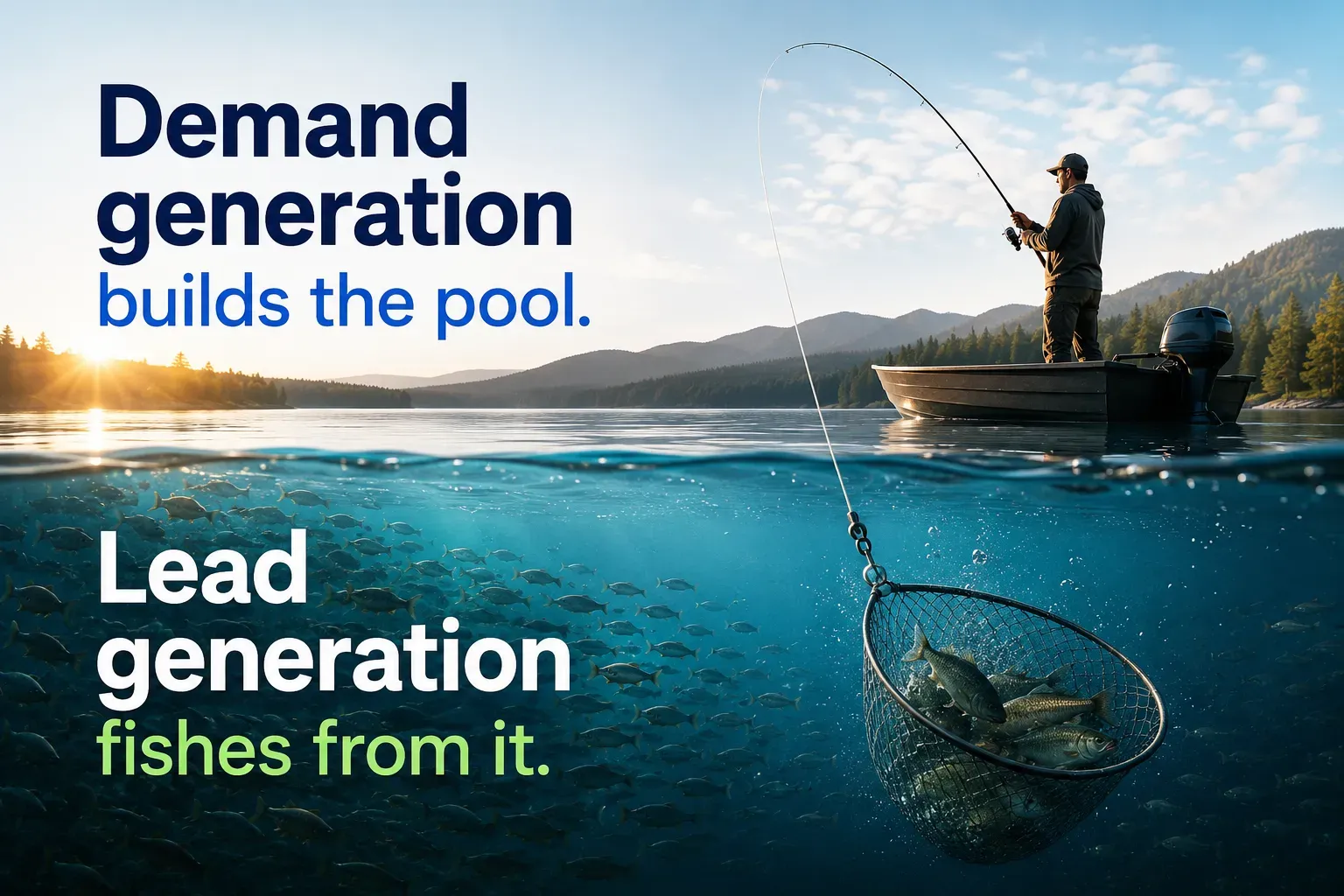
Demand generation builds the pool. Lead generation fishes from it.
Don't you just love ChatGPT generated images?
They're Sequential, Not Competing
The most expensive mistake in B2B marketing is running demand gen and lead gen as parallel tracks with separate teams, separate budgets and separate definitions of success.
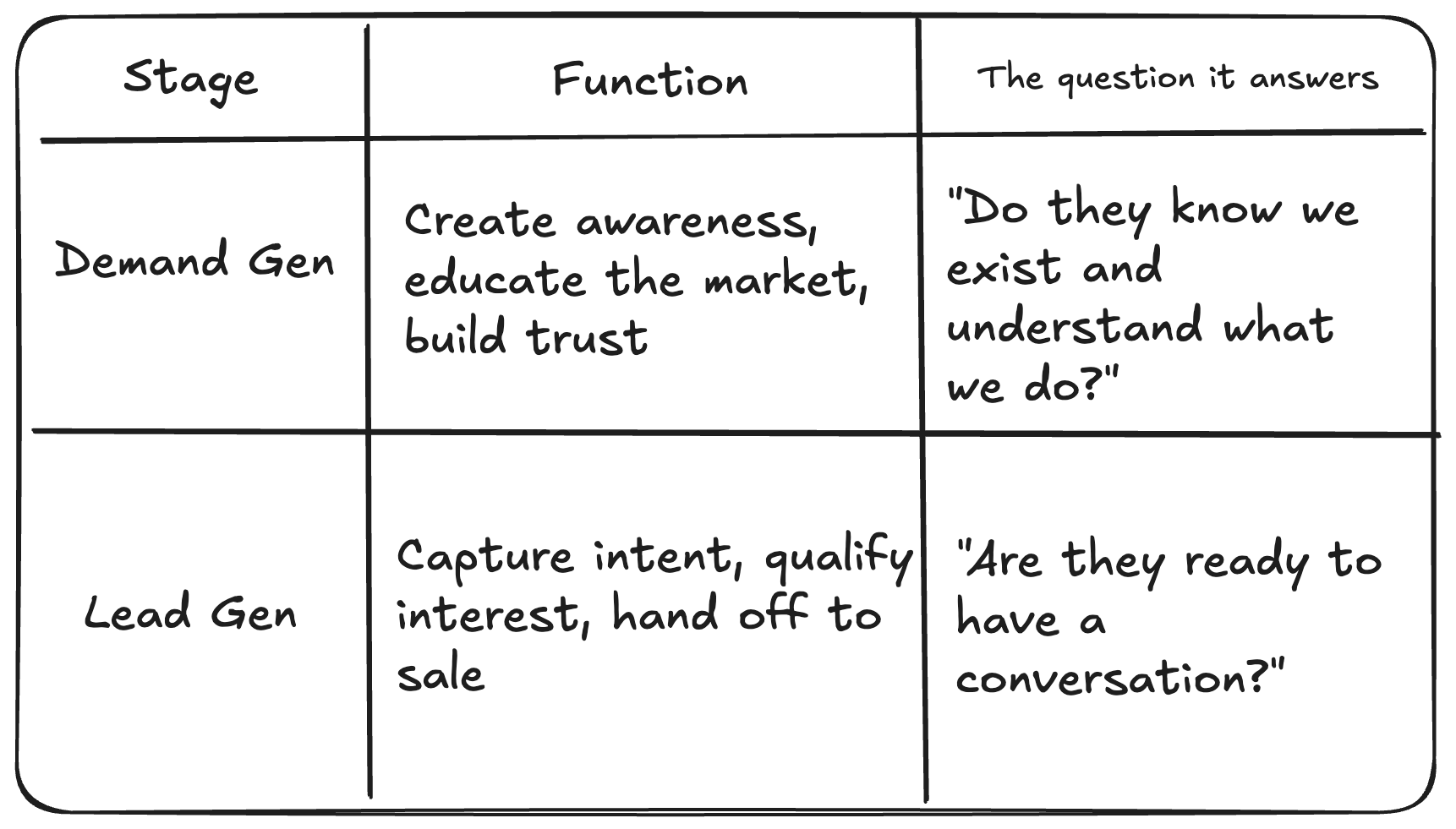
Here's how they actually relate:
Stage
Function
The question it answers
Demand generation
Create awareness, educate the market, build trust
"Do they know we exist and understand what we do?"
Lead generation
Capture intent, qualify interest, hand off to sales
"Are they ready to have a conversation?"
Demand gen is upstream. Lead gen is downstream. Every lead you generate was first a demand gen contact, someone who encountered your brand through content, a webinar, an ad or word of mouth before they filled out a form or clicked a pricing page.
When a marketing team invests heavily in lead gen without investing in demand gen, they're fishing in a pond they haven't stocked. When they invest in demand gen without a lead gen mechanism, they're building an audience with no path to revenue. Companies that coordinate both stages consistently see 30% more qualified leads and 20% more revenue year over year compared to teams running them in isolation, according to HubSpot research.
Real Use Case: Where Most B2B Teams Go Wrong:
Let's look at real examples and where B2B teams make mistakes. In this example, we'll be using webinars to drive out point home. You can of course also apply this to other content formats, such as eBooks for example.
Demand Gen or Lead Gen?
Mistake 1: treating registrations as a leads
This is the failure mode we see most often. A marketer runs a webinar, exports the registrant list and sends it to sales. The sales team calls down the list. Most people don't answer. The few who do weren't expecting the call.
The problem is that registering for a webinar is a demand gen signal — it means someone was interested enough to sign up. It doesn't mean they're ready to buy. The qualification happens during the event, through watch time, poll responses, questions asked and CTAs clicked. A registrant who watched 80% of the session and asked a question about pricing is a fundamentally different prospect from one who registered and never showed up.
Passing the full registrant list to sales is the operational equivalent of calling everyone who clicked your LinkedIn ad. You're treating demand signals as purchase intent and the conversion rate reflects it.
This is exactly what Levan at UserGuiding identified when their webinar program was generating fewer than 15 registrations per session: "Most of the people just share the registrants list and let's see how it goes, but it's not the right format." Once they rebuilt the program around proper qualification and follow-up logic, the same channel generated 20+ directly attributed customers across 20 events.
Mistake 2: measuring demand gen with lead gen metrics
Demand gen takes time. Brand awareness, content engagement and pipeline influence don't show up in this quarter's SQL count. When marketing leaders measure demand gen programs using the same metrics as lead gen, MQLs and directly attributed pipeline, they declare them failures and cut the budget before the compounding effect kicks in.
The correct measurement framework is multi-touch attribution. Demand gen contributes to deals as one touchpoint in a longer journey. "Influenced pipeline" rather than "generated pipeline" is the accurate way to report it. Presenting a webinar as solely responsible for $500K in pipeline when it was one of six touchpoints will eventually erode trust with your CFO.
Mistake 3: no defined handoff between stages
Demand gen works until the moment it fails to hand off to lead gen. Without a defined trigger — a threshold of engagement that moves someone from "audience member" to "sales prospect" — contacts accumulate in the CRM without ever converting.
The fix is a behavioural qualification model. Not just a form fill. Not just a job title match. A set of actions the prospect took that signal readiness: watched 75%+ of a webinar, clicked a product CTA, asked a question about implementation timeline, attended three events in a quarter. These are the actions that distinguish demand from intent.
Webinars: Where Both Stages Happen Simultaneously
Webinars are the clearest practical illustration of how demand gen and lead gen work together — and the sharpest test of whether your team understands the distinction.
A webinar is a demand gen asset from the moment of registration through to the live session. You're educating the audience, building trust, demonstrating expertise. No one is being sold to directly. Research from Demand Sage shows 73% of B2B marketers and sales leaders say webinars are highly effective for quality lead generation, which reflects their value at both stages, not just one.
The lead gen layer activates during and after the event, based on what each individual attendee actually did. Watched 75% of the content? Answered the pricing poll? Asked a question about integration timelines? Those are purchase intent signals. That person is no longer just an audience member, they're a qualified lead for your sales team to act on.
This is the distinction that separates webinar programs that generate pipeline from those that generate registrant lists. The lead gen layer doesn't activate automatically, it requires that engagement data flows into your CRM as structured, actionable signals, not a flat attendance export.
At airfocus, applying this kind of behavioural qualification to their webinar programme resulted in approximately 65% of attendees becoming MQLs. At Alleo, around 60% of their pipeline was introduced to the company through a webinar. These aren't outcomes from content events — they're outcomes from programs that treated demand gen and lead gen as a connected sequence.
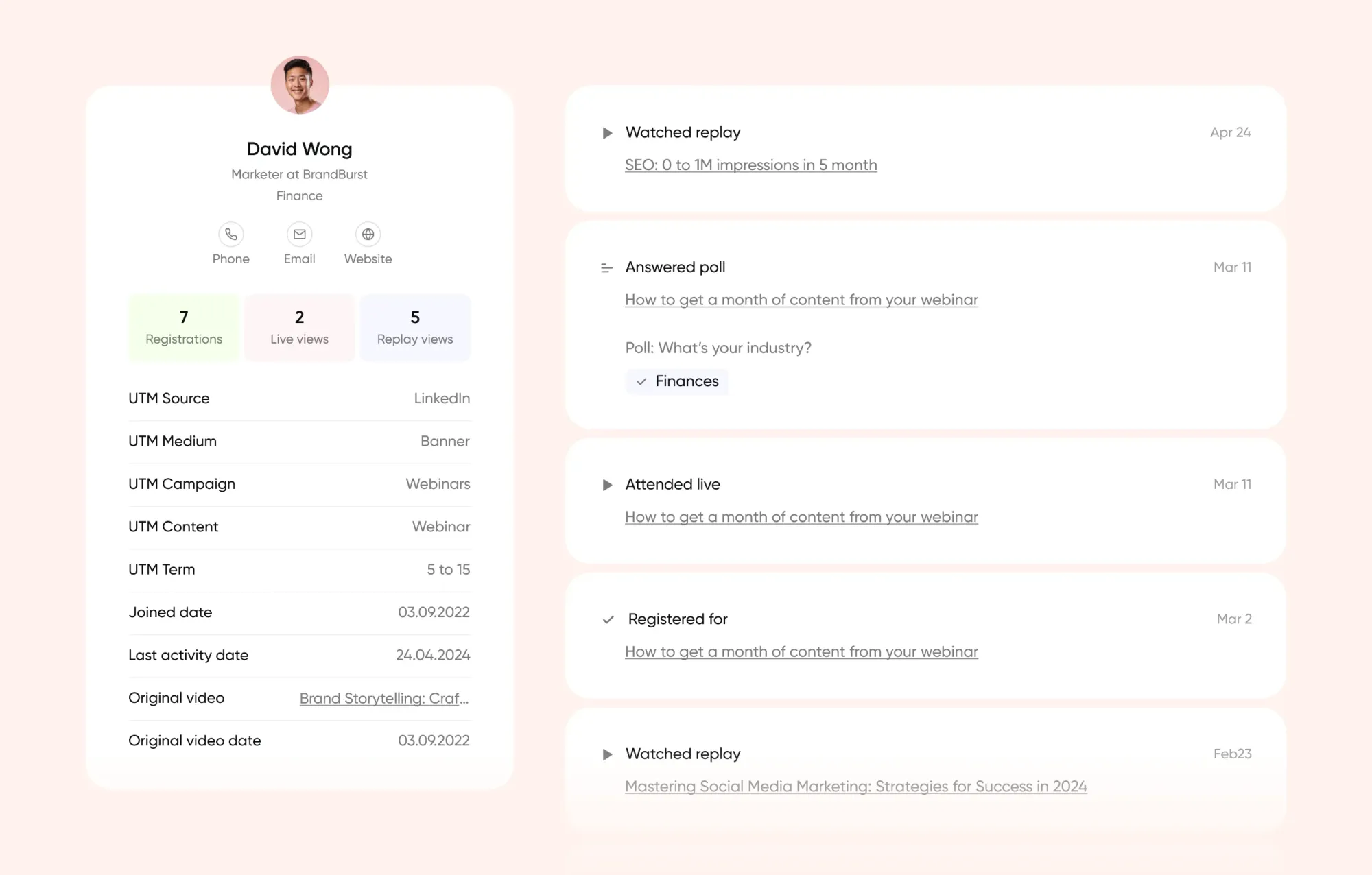
For webinar lead generation to work at that level, the engagement data needs to flow directly into your CRM without manual exports. Every watch time update, every poll answer, every Q&A question needs to become a CRM property or an activity that sales can act on.
💡
Want more data from your webinars? Check out Contrast webinars and receive 50+ data points per attendee in your CRM.
The Handoff Framework: From Demand to Lead in Practice
The shift from demand gen contact to qualified lead is not a single moment, it's a threshold. Here's a practical framework using webinar engagement as the example, because it's where we see the demand-to-lead conversion most visibly:
Demand gen contacts — nurture, do not push to sales:
Registered but did not attend
Attended but watched less than 50% of the content
No poll responses, no questions asked, no CTA clicks
Qualified leads — route to sales or high-intent nurture:
Attended live and watched 75%+ of content
Answered a poll with a high-intent response (pricing, demo, evaluation timeline)
Asked a question in Q&A — particularly about implementation, pricing or integration
Clicked a CTA during the session
We recommend building this into your CRM directly. For example, by using the lead scoring feature: 75%+ watch time adds 15 points, a Q&A question adds 10, a CTA click adds 20. A composite score above 30 routes to sales; 10–29 goes to a nurture sequence; below 10 stays in long-term demand gen. For tracking the right webinar KPIs, this behavioural scoring model is more predictive than any single engagement metric on its own.
The 68% of webinar attendees who say they're more likely to buy from a company after attending one of their sessions, that outcome doesn't come from attending. It comes from the experience of high-quality content followed by a follow-up that treats them as the specific person they demonstrated themselves to be during the event.
This is the operational version of the demand gen / lead gen distinction: not a strategic framework on a whiteboard, but a set of signals that tell your team exactly when demand has become intent and how you can act on that data.
For the full breakdown of connecting webinar engagement data to revenue in HubSpot, see our guide on pipeline attribution.
Bringing These Key Differences Together
Key Differences Between the Two Camps
Demand generation and lead generation only become powerful when you stop treating them as rival camps and start designing them as a single, continuous system.
Upstream, demand gen does the heavy lifting of earning attention, educating the market, and building trust with the right people long before they’re ready to talk to sales. Downstream, lead gen turns that trust and familiarity into qualified conversations and, ultimately, revenue, but only when it activates at the right moment, based on real buying signals rather than vanity actions.
Webinars are where this comes into sharpest focus. A registration is not a lead; it’s an invitation to prove your value. Watch time, questions, poll responses, and CTA clicks are the behaviors that separate curious audience members from buyers with intent. When those signals flow directly into your CRM and trigger clear next steps, webinars stop being “just another campaign” and become one of the most reliable engines for pipeline you have.
The teams that win aren’t the ones shouting the loudest or collecting the most form fills. They’re the ones who:
Invest in demand gen early and consistently, so the pond is always stocked.
Define a clear, behavior-based threshold where demand becomes intent.
Operationalize that handoff in their CRM and routing rules, so sales only works the leads that are actually ready.
Do that, and the false tradeoff between demand gen and lead gen disappears. Instead of arguing about which one deserves the budget, you’re optimising a connected sequence that turns attention into revenue — predictably, repeatedly, and at scale.
Turn webinars into measurable revenue
Sync your CRM with Contrast and finally see what’s driving ROI
What's the main difference between demand generation and lead generation?
Demand generation creates awareness and builds interest in your product before buyers are ready to purchase. Lead generation captures that interest as a named contact in your CRM. They're sequential stages: demand gen is upstream, lead gen is downstream. You can't generate qualified leads without first generating sufficient demand — which is why teams that skip demand gen struggle with lead quality even when lead volume is high.
Can you do lead generation without demand generation?
You can capture form fills without a demand gen programme, but the quality will be poor. Without prior education and trust-building, leads don't understand your product well enough to buy quickly. Sales cycles are longer, close rates are lower and churn is higher — because the lead wasn't actually ready when they were captured. The cost per acquired customer ends up significantly worse than a coordinated demand gen → lead gen approach.
Which should B2B teams invest in first?
Demand generation. Without an audience that knows you exist and trusts your expertise, lead gen mechanisms capture people who haven't yet formed a preference. The practical exception: if you already have an existing audience through organic search, partnerships or brand recognition, lead gen can run in parallel from the start.
What metrics do you use for demand generation vs lead generation?
Demand gen metrics: MQLs, cost per MQL, pipeline influenced (multi-touch), content engagement, time to first sales conversation. Lead gen metrics: SQLs, MQL-to-SQL conversion rate, pipeline generated (direct attribution), cost per SQL. The most common measurement mistake is applying lead gen metrics to demand gen programmes and declaring them failures before the compounding effect has had time to work.
How do webinars fit into demand gen vs lead gen strategy?
Webinars serve both stages simultaneously, which makes them unusually efficient. The live session is a demand gen asset — you're educating, building credibility, creating trust. The lead gen layer activates based on individual engagement signals: watch time, poll responses, Q&A questions, CTA clicks. Attendees who cross behavioural intent thresholds become qualified leads. Those who registered but didn't attend remain demand gen contacts to nurture.
What does a good demand gen → lead gen handoff look like?
A good handoff is behaviour-based, not just form-based. The trigger for moving someone from "audience" to "qualified lead" should be a set of actions they took — not only a job title match or a form fill. In practice: attendees who watched 75%+ of a webinar and clicked a CTA route to sales, while everyone else goes to a nurture sequence. The handoff works best when engagement data flows automatically into your CRM with no manual export required.
Is demand generation the same as inbound marketing?
They overlap but aren't identical. Inbound marketing is a methodology focused on attracting buyers through content and SEO rather than interrupting them with outbound tactics. Demand generation is broader — it includes inbound tactics like content and webinars, but also paid reach campaigns, direct mail, events and community building. Think of inbound as one of the primary channels within a broader demand generation strategy.