
A 21-year-old college student created one of the most successful marketing campaigns in history during a summer internship.
Her idea generated billions of impressions over the years. It turned millions of people into unpaid advertisers. It became so influential that a lot of industries copied it.
The company made billions. But she got nothing. No credit. No job. No equity.
Let me back up.
Every December, millions of people voluntarily create content for companies they already pay. They don’t get compensated. They don’t even get asked. They just... do it.
They share their music stats. Their language learning streaks. Their workout achievements. Their dating app analytics. Even their grocery shopping habits.
This is Wrapped season. And it might be the most brilliant psychological manipulation in modern marketing.
But the format that made this whole thing explode – the swipeable, shareable Instagram Story version that actually went viral came from an intern.
Let’s get into the origin of the story.
The Origin Story (Or: How We Got Here)
Back in 2015 Spotify launched something called “Year in Music.” It was boring as hell. They emailed you a link. You clicked it. You saw your top songs, and that’s it.

Then in 2016, they rebranded it to “Wrapped” and started playing with the formula. But the real transformation didn’t happen until 2019, when Spotify Wrapped turned into an Instagram story format.
According to multiple reports, a 21-year-old Howard University student named Jewel Ham developed the interactive story concept during her 2019 summer internship at Spotify. She pitched the idea on her last day. They loved it. She left.
The next year, Wrapped exploded into the viral phenomenon that now defines December. And Ham never got credit for this.
Spotify denied her claims, naturally, saying hundreds of employees contributed. But Ham shared her original design mockups on Twitter, and they look suspiciously like what we scroll through every December.
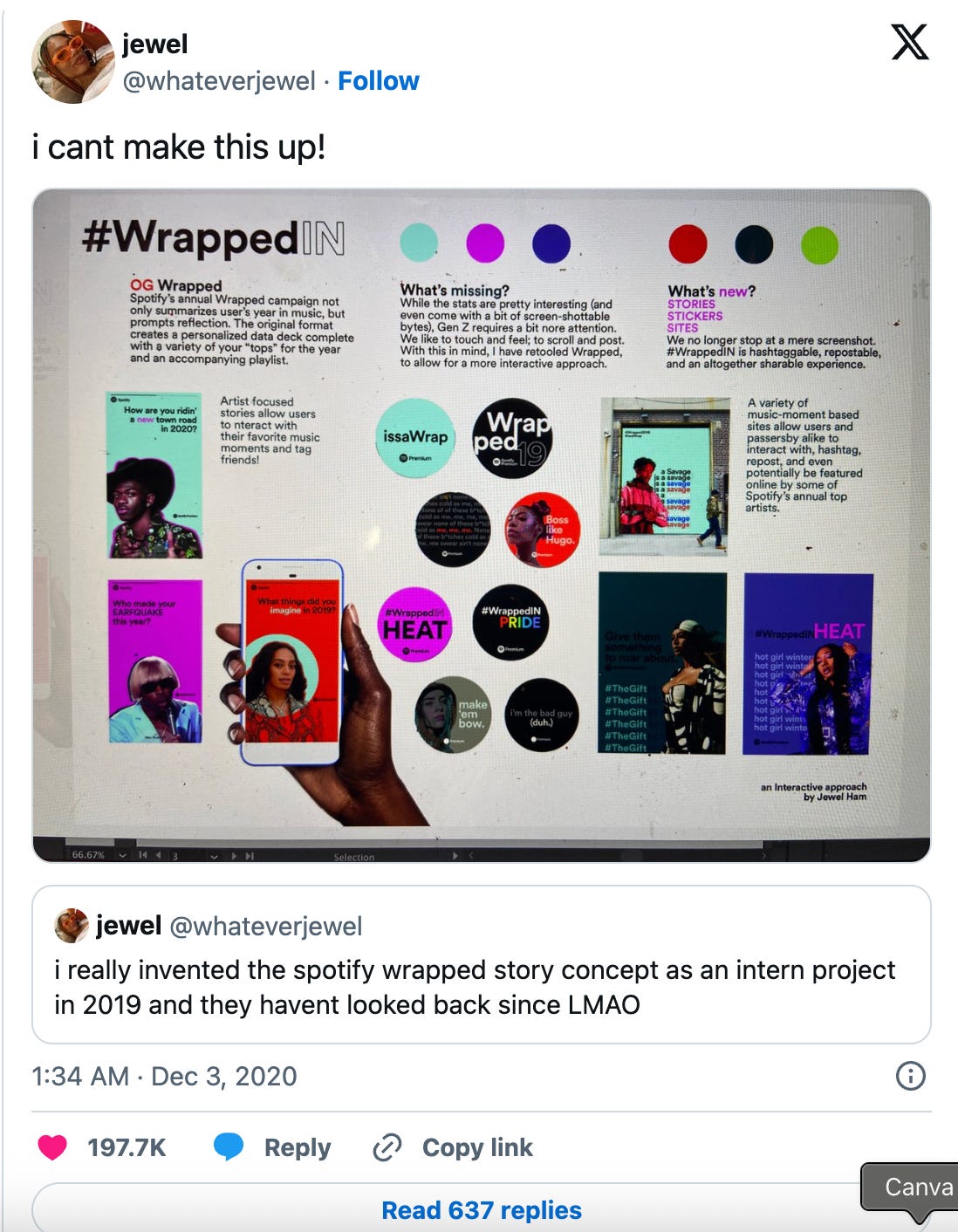
Draw your own conclusions, but if you’re an intern reading this: get that shit in writing. And maybe don’t pitch your billion-dollar idea on your way out the door.
The Psychology: Why We Happily Advertise for Free
Alright, let’s talk about why this works so disgustingly well on our brains.
Wrapped campaigns succeed because they hit six psychological triggers at once:
- narcissism (it’s about YOU),
- FOMO (everyone’s doing it),
- status signaling (humble bragging),
- surprise (wait, I did what?),
- perfect timing (December nostalgia),
- and the illusion of a gift (feels free, costs nothing).
Let’s break down each one.
We’re All Narcissists (And That’s Fine)
First up: personalization. This isn’t Spotify (or any other company) showing you THEIR data. It’s showing you YOUR data. And we’re obsessed with ourselves.
When was the last time you shared a company’s ad? Never, probably. But Wrapped isn’t framed as an ad. It’s framed as YOU. Your taste. Your year. Your personality in audio form.
They’re basically holding up a mirror and going “wow, look how interesting you are!” And we eat it up every time because the mirror has better lighting than reality.
It’s the same reason people take personality quizzes that tell them they’re “an INFJ” or “a Hufflepuff” or whatever. We want external validation for our internal sense of self. Wrapped just does it with data.
FOMO is a Hell of a Drug
In December 2020, Spotify saw app downloads jump 21% right after Wrapped dropped. Why? Because everyone was posting theirs, and if you weren’t in on it, you looked like you were living under a rock.
The social pressure is REAL. Your college roommate posts theirs. Your coworker posts theirs. Your cousin posts theirs, etc, etc.
At some point, you either post yours or accept that you’re the only person not participating in the year’s biggest cultural moment. And nobody wants to be that person.
The Humble Brag Economy
Let’s be honest about what’s really happening here. Wrapped turns your data into status symbols.
“I’m in the top 0.1% of listeners for this artist” really means “I’m cooler than you and I discovered them first.” It’s social capital. It’s proof you’re not basic.
We all KNOW we’re bragging. We just can’t do it directly because that’s obnoxious. So Wrapped gives us cover. “Oh, I’m not bragging, I’m just sharing my stats!”.
Your music taste becomes your personality. Your Duolingo streak proves you’re disciplined. Your workout stats show you’re not lazy. Every metric is a tiny flex packaged as “innocent” sharing.
And the beauty is, it works because the brag looks humble. You’re not saying “I’m better than you.” The data is saying it for you.
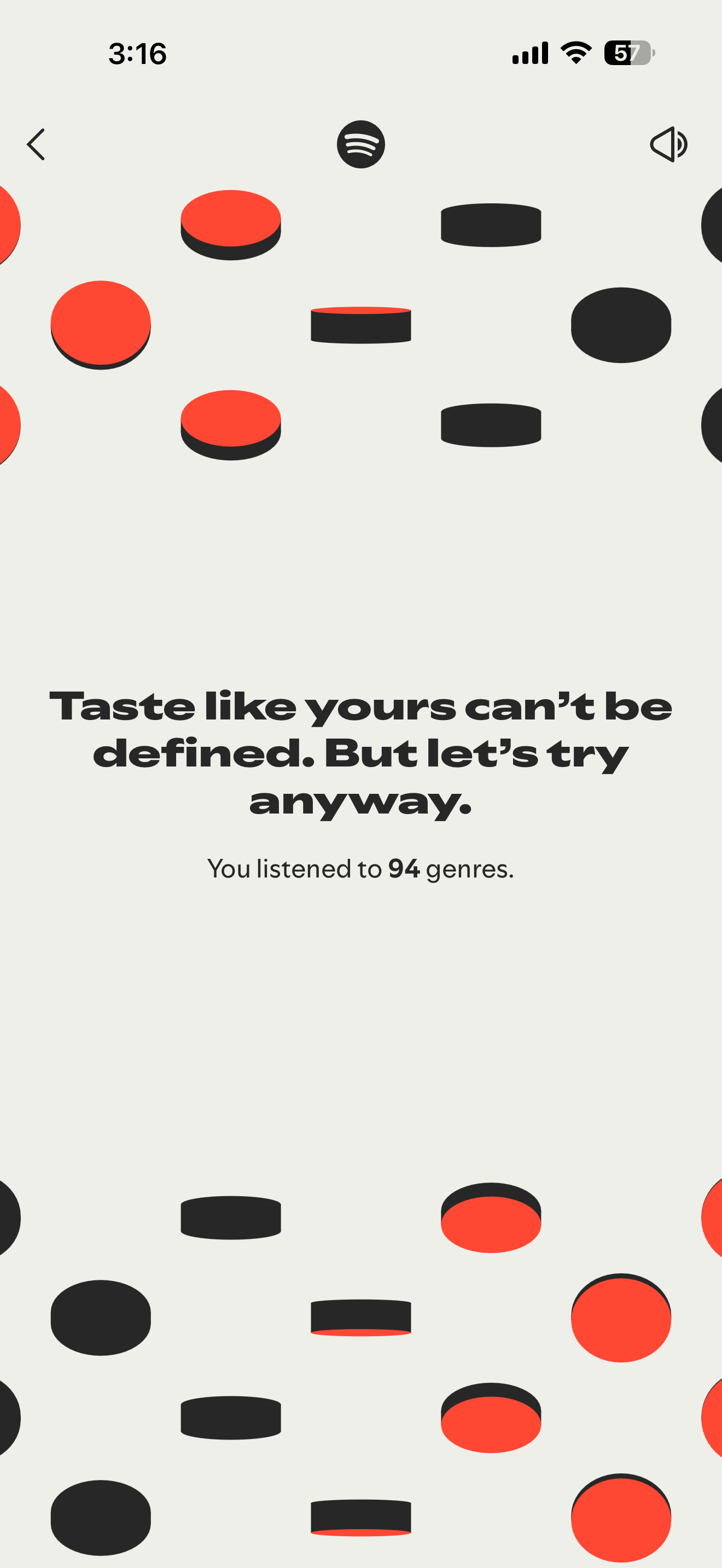
They are literally telling me I am sooo unique and you want me not to share this?
The “Wait, I Did What?” Factor
There’s also something deeply psychological about seeing your own behavior reflected back at you. Like, you didn’t realize you listened to that one song 247 times until Spotify told you. You had no idea you spent 40 hours learning Spanish until Duolingo guilt-tripped you with a cute owl.
The surprise element makes it shareable.
It hits every emotional button: surprise, nostalgia, pride, embarrassment, validation. It’s an emotional slot machine, and every spin feels like winning even when you’re losing.
Timing is Everything
They drop this in early December – right when everyone’s feeling reflective and nostalgic. The holidays are coming. The year is ending. You’re thinking about resolutions and looking back at where the year went.
It’s not an accident. They’re catching you at your most sentimental, when you’re most likely to share and engage. If they dropped this in like, March? Nobody would care. But December? Everyone’s already in their feelings.
It Feels Like a Gift (Even Though It’s Not)
Wrapped doesn’t ask for anything. You’re not buying anything. You’re not signing up for a new tier. You’re not giving them more data than they already have.
You’re just getting a pretty package of your own behavior. It feels like they’re GIVING you something. Like it’s a present.
In fact, they’re repackaging data they already collected (that you already gave them) and making you do their marketing for free.
It’s brilliant specifically because it doesn’t feel transactional. There’s no immediate ask. The conversion happens later, organically, when you’re so charmed by the whole thing that you stay subscribed or upgrade or tell your friends to join.
They’re playing the long game, and we’re all falling for it.
How It Evolved (And Got Even Smarter)
The beauty of Wrapped isn’t just the original idea, it’s that they keep iterating on it.
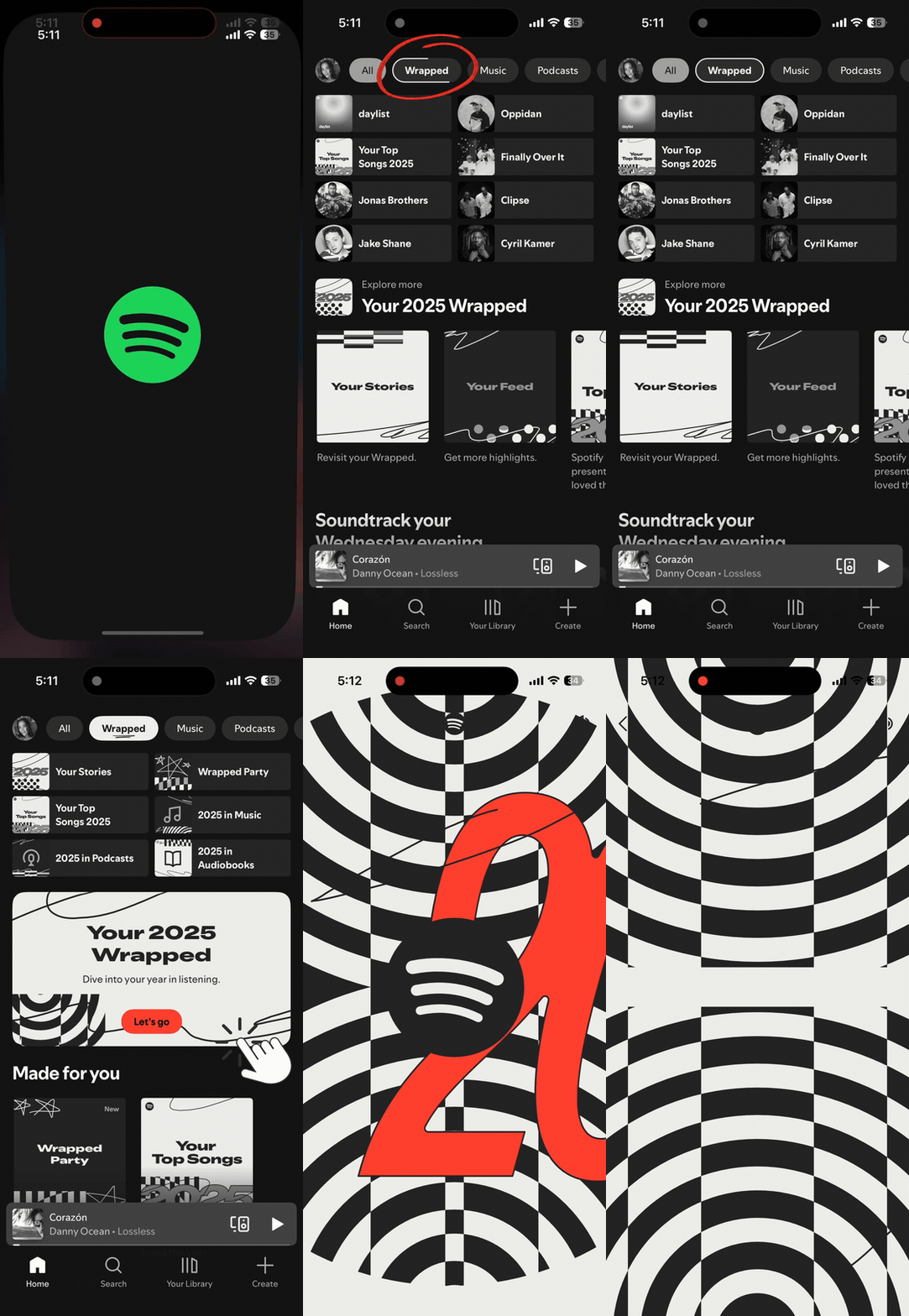
2018: They added your “audio aura” and the oldest song you listened to.
2019: The Story format drops (thanks, Jewel).
2020: Podcast stats get added, plus cute little badges.
2021: Audio personality types and 2021: The Movie trailers.
2022: Artist messages and “listening personality” classifications.
2023: “Sound Town” matching you with cities based on taste.
2024-2025: Even more personalized storytelling and community features.
Every year they add something new. They keep it fresh. They keep you guessing what’s next. Because if it was the same thing every year, you’d get bored. But they’re always adding a new psychological hook. And the simple reason this works is because of variable reinforcement. Our brains get excited by surprises – we pay more attention when we don’t know what’s coming. When something changes a little each year, it feels new again, and that tiny bit of unpredictability keeps us interested. If everything stayed the same, we’d stop caring, but the constant “new thing” resets our curiosity and keeps us coming back.
And the results? This year, Wrapped hit 200 million users in the first 24 hours – a 19% increase from last year. Over 500 million shares. Half a billion people advertising for them. For free.
Everyone Wants In (Even Companies That Probably Shouldn’t)
Once Spotify proved you could trick people into advertising for you, everyone wanted a piece.
The obvious ones jumped in: Apple Music’s “Replay,” YouTube Music’s “Recap,” Tidal’s “My Rewind.” All fine. All exactly what you’d expect.
Duolingo started doing year-in-review recaps of your language learning journey.
Tinder created “Year in Swipe” where they show you dating stats and create “vision boards” for your love life.
Equinox gives you fitness achievements.
Aldi made a grocery shopping recap.
Reddit started doing user recaps showing your most-visited subreddits and karma stats.
Peloton gives you workout stats, etc, etc.
B2B Wrapped: How to Apply This in B2B
This is for those of us in the B2B world.
Everyone’s obsessed with B2C Wrapped campaigns, but there’s a massive opportunity in B2B SaaS that barely anyone is touching.
Why aren’t B2B companies doing this more?
Most companies are thinking about it wrong.
They’re asking “how do we make this go viral?” when they should be asking “how do we make this valuable?”
Because B2B Wrapped doesn’t need to be publicly shareable to work. It doesn’t need to flood LinkedIn (though it could, as a carousel if you do it right). It just needs to do three things:
- Validate the user - Show them they’re actually good at their job
- Justify the spend - Prove the tool was worth the money
- Create an emotional connection - Make them feel something other than “this is just another SaaS tool”
It’s soooo good for your retention. When renewal time comes, you’re not just another SaaS tool, you’re the platform that helped them achieve all that.
Three Ways to Actually Do B2B Wrapped
1. The Annual Recap (Classic)
Send an end-of-the-year summary. Make it visual, use their brand colors. Include both personal stats AND aggregate platform data (if available)(e.g.,”Our users completed 1 million tasks this year, and you did 47 of them!”).
One marketer reported 30-35% open rates on these emails vs their usual 26%.
2. End-of-Trial Wrapped
If you have a free trial, show users what they accomplished in 30 days and SHOW what they could do in a year.
“You created 12 designs in your trial. At this rate, you’ll create 144 this year and save 60 hours of work.”
It’s Wrapped for better conversion :D. You’re not selling, you’re showing them what they’re about to lose.
3. Renewal Time Wrapped
Timing this for the end of billing cycles is sneaky but effective. Right when they’re deciding whether to renew, you remind them of all the value they got.
“You’re about to lose access to the tool that saved you 127 hours this year. Still want to cancel?”
A Real Example: What B2B Wrapped Could Look Like
Let me show you what we did at Contrast.
Webinar hosting is kind of a shitty job.
Nobody signs up thinking, “Yeah, I want to talk to a silent audience for an hour while juggling slides, chat, Q&A, and whatever tech issue pops up today.” But somehow… they do it anyway.
Nobody talks about them. Nobody celebrates them. But they’re out there going LIVE in real-time, no edits, no do-overs, representing their entire company for an hour straight.
One wrong answer? That’s your company’s reputation on the line. Technical glitch? Everyone’s watching. Awkward silence? The whole audience feels it.
So we built our Wrapped around one simple idea: make these people feel special, because they really are.
We wanted to put webinar hosts in the spotlight for once. Because if anyone deserves a yearly “look what you accomplished” moment, it’s the person who went live 47 times this year without having a panic attack.

Want to Run Better Webinars?
Get a personalized demo and see how Contrast can elevate your webinars
Book your demoHere’s what we show in our Wrapped:
The Hero Metrics:
- Your most-watched webinar (your greatest hit)
- Total hours streamed (you created a lot of content)
- Total hours watched (people actually cared)
- Total attendees (your audience size)
The Engagement:
- Average webinars watched per person (loyalty metric)
- What % watched more than 1 webinar (retention proof)
- Your best month (you peaked here)
- Polls launched (you kept it interactive)
- Total votes collected (engagement, baby)
- CTAs created (you’re driving action)
- Total clicks (and it’s working)
- Your most-answered poll (this one resonated)
And we ended with our “Smashing Webinars” message. So even people who DON’T use Contrast but saw someone else’s Wrapped got hit with “Sign up now to get YOUR Smashing Wrapped in 2026.”
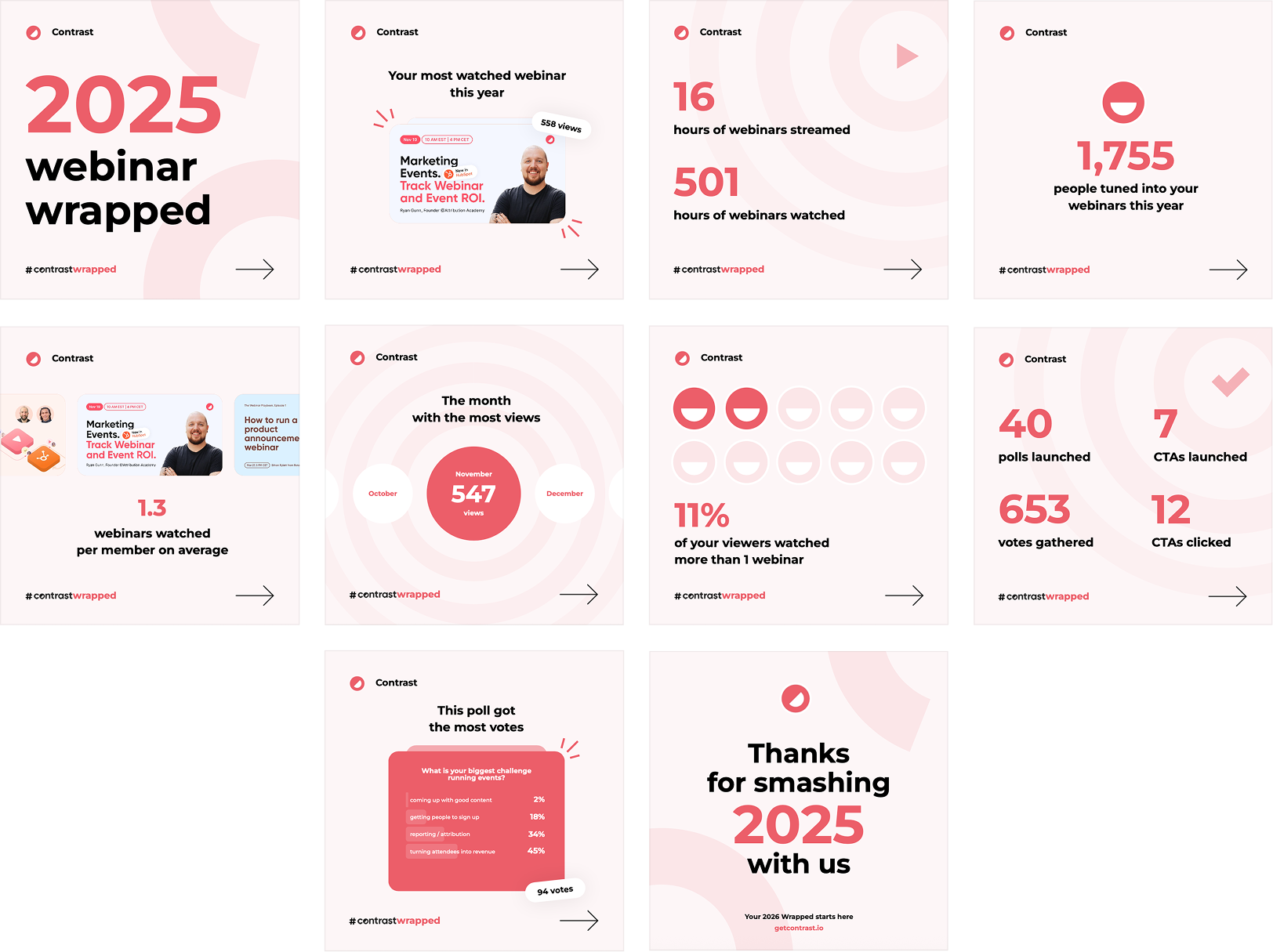
See what we did there? Every metric tells a story:
- “Hours streamed” = you worked hard
- “Hours watched” = people valued your work
- “Repeat viewers” = you’re building an actual audience, not just one-time viewers
- “Poll engagement” = you’re not just talking AT people, you’re talking WITH them
It’s not just data. It’s validation. It’s proof that all those webinars you stressed over? They mattered.
You know how Spotify shows you your #1 artist and you feel personally validated? We did the same thing with “Your Most-Watched Webinar.”
It’s not just a stat. It’s your BEST work. The webinar that resonated most with your audience.
When someone sees “Your Q3 Product Launch webinar got 2,400 views,” they don’t think “cool number.” They think “I CRUSHED that webinar.” It becomes a personal achievement, not a data point.
We’re tapping into the same ego-stroking that makes people share their top 0.1% listener status. Except instead of music taste, it’s professional competence. And professionals are DESPERATE to feel competent.
What KPIs to Track in B2B Wrapped
Do you count shares? Track opens? Do you celebrate when someone posts their Wrapped on LinkedIn?
Cool. But did you check if they renew?
B2C Wrapped can afford to chase virality because brand awareness = revenue. But in B2B? Shares don't pay the bills. Renewals do.
So if you're building a B2B Wrapped campaign, here are the metrics you should actually care about:
1. Retention Rate
Track users who received Wrapped vs. those who didn't. Compare renewal rates.
How to measure: Cohort analysis. Split users into "received Wrapped" vs "didn't receive Wrapped" and track the retention.
2. Feature Adoption Post-Wrapped
Did seeing their stats make them use the product MORE?
Look at DAU/MAU in the 30 days after they view their Wrapped. If someone sees they only used 3 of your 10 features, do they start exploring more?
How to measure: Compare average features used per user in the 30 days before Wrapped vs. 30 days after.
3. Upgrade/Expansion Revenue
Your Wrapped should make users realize they're hitting limits.
"You're in the top 10% of users by volume. Upgrade to handle 3x more." That's not only a stat. That's also a sales pitch.
How to measure: Track upgrade rate in the 60 days post-Wrapped vs. your baseline conversion rate.
4. Social Proof
Okay fine, shares DO matter in B2B. But measure them correctly.
Don't just count LinkedIn posts. Track:
- Tagged shares (did they tag your company?)
- Shares with positive sentiment
- Shares that triggered demo requests or inbound leads
A share that generates 3 demo requests is worth 1000x more than a share that gets 50 likes.
How to measure: Use social listening tools + track inbound source attribution for 2 weeks post-campaign.
5. Champion Identification
Your Wrapped reveals your power users. These are your expansion opportunities, your case studies, your advocates.
If someone's in the top 5% of users, they should be in your Customer Advisory Board by Q1.
How to measure: Create a "power user" segment based on Wrapped metrics and track how many convert to advocates, references, or case studies within 6 months.
Wrapped isn't a campaign. It's a retention play. Measure it like one.
If your Wrapped doesn't improve retention or expansion revenue, it's just a pretty email. And pretty emails don't save your churn rate.
The Bottom Line
It’s manipulation. It’s data mining. It’s brilliant.
And it works in B2B too. You just have to have the guts to try it.
Your users’ data is boring until you make it about THEM. Then it’s shareable. Then it’s valuable. Then it’s free ads.
So whether you’re building a consumer app or selling enterprise software, the lesson is simple: stop thinking about what you want to say and start thinking about what your users want to brag about.
Give them the mirror. Make it pretty. Watch them post.
Now if you’ll excuse me, I need to go share my Wrapped and pretend I’m not participating in capitalism’s most successful psychological experiment.
P.S. If you’re reading this in December and haven’t posted your Wrapped yet, are you okay? Do you need someone to talk to?
P.P.S. To the person who’s definitely going to read this entire blog and then NOT implement Wrapped for their product because “our users wouldn’t be into that” - yes they would. You’re just scared. Do it anyway.
P.P.P.S. Jewel Ham, if you’re reading this: You deserved equity, a promotion, and your name in 72-point font on every Wrapped screen. The system is broken, and we all know it.