
"Tell us about yourself" is not a fireside chat question.
It's a placeholder for a host who hasn't done the work and an invitation for the guest to deliver a five-minute origin story the audience will mentally check out of before it ends. It also signals something worse: the moderator thinks the fireside chat is about the guest.
It's not. It's about the audience.
Every question a moderator asks is a bet on what the people watching actually need to hear. The best fireside chat hosts we've seen operate as the audience's advocate, asking the questions attendees are thinking but can't articulate, pushing back when a guest gets vague and keeping the conversation on the topic people registered for. That's a different orientation than "let's find out what our guest has to say."
If you're still working out the format itself, how a fireside chat differs from a panel or keynote, what a fireside chat is and how to host one covers that ground. This article assumes you're past that, working on the question design problem.
The question arc most moderators ignore
Most people don't ask bad questions per se. They ask good questions, but in the wrong order. To deliver a good fireside chat is all about the arc.
Most hosts treat the fireside chat like an interview, ten questions, worked through in sequence, guest answers, move on. By question four, half the room is checking their phone, or has opened another tab if the fireside chat is virtual.
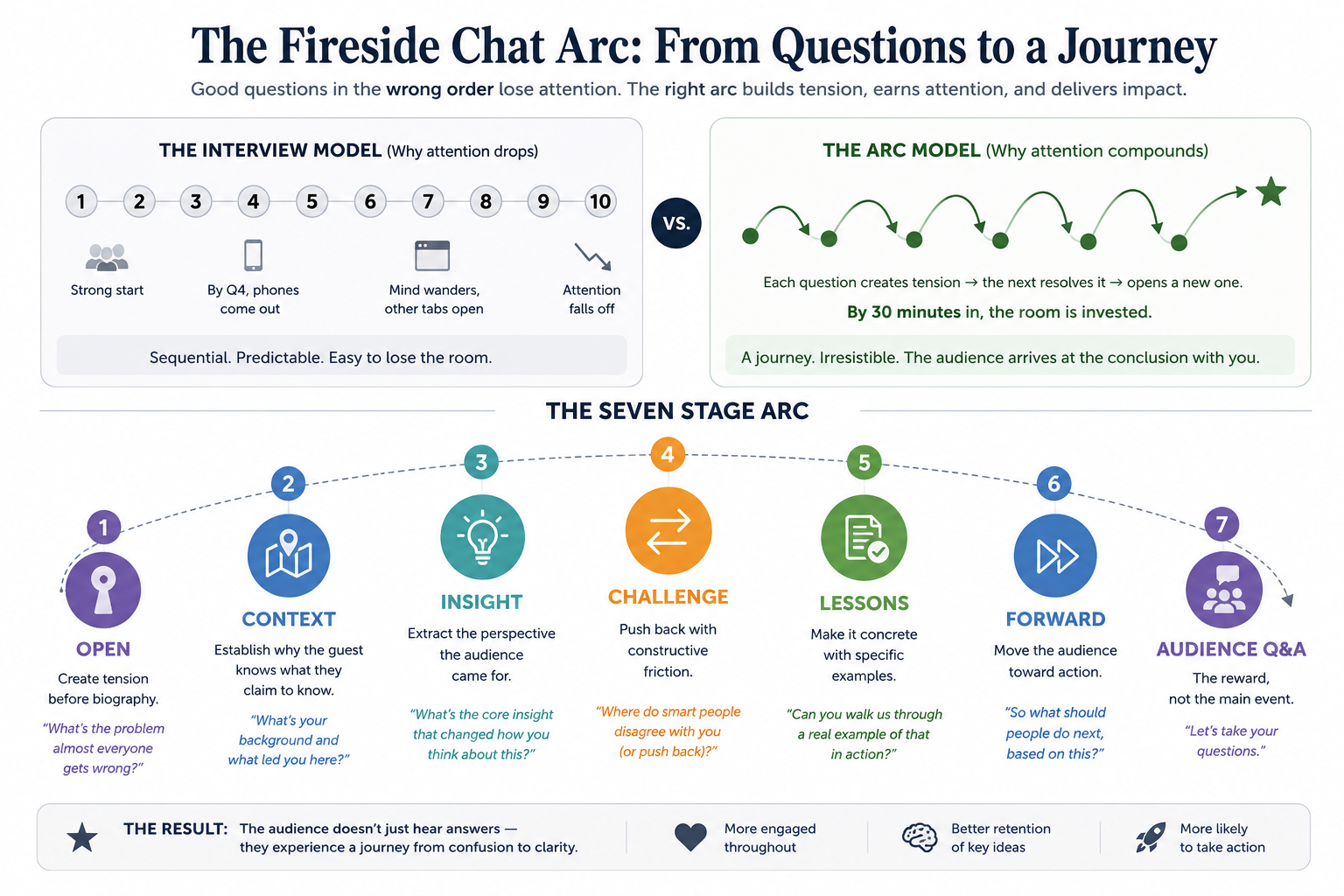
The better model is an arc. Each question creates a small tension. The next resolves it, then opens a new one. By the time you're 30 minutes in, the audience has followed a thread from "here's the problem everyone gets wrong" to "here's how to actually fix it", and they feel like they arrived at that conclusion through the conversation rather than being told.
The arc has seven stages:
- Open — create tension before biography
- Context — establish why the guest knows what they claim to know
- Insight — extract the perspective the audience came for
- Challenge — push back with constructive friction
- Lessons — make it concrete with specific examples
- Forward — move the audience toward action
- Audience Q&A — the reward, not the main event
Plan for 45–60 minutes. Spend roughly 10 minutes on stages one and two combined, 25–30 minutes on stages three through five, and 10–15 minutes on six and seven. The questions below are organized to follow this arc.
50+ fireside chat questions, organized by stage
Opening questions: create tension, not biography
The first question should not ask the guest to introduce themselves. That's the moderator's job in a sentence or two. Your opening question should position the guest against a belief or assumption the audience currently holds. That gap is what makes people lean in rather than check their phones.
- Most [audience role] approach [topic] by doing [X]. You've said that's exactly wrong. Where does that gap come from?
- What's the most common mistake you see [job title] making right now — and why does everyone keep making it?
- You've been pretty public about disagreeing with [conventional wisdom]. Our audience is largely still operating that way. What are they missing?
- If you had to name one belief that almost everyone in [your industry] holds that you think is genuinely wrong — what is it?
- Five years ago, [approach] was the consensus. What changed your thinking?
- What question do you wish someone would ask you about [topic area] — but nobody ever does?
- What's your most controversial take on [topic] — one sentence?
- Give me the version of this conversation you'd have at a conference bar, not a conference stage.
One of these, not all of them. The opening hook is a single well-placed question. A sequence of provocations signals you're trying too hard.
Background and context questions: earn credibility after the hook
Once the tension is set, the audience wants to know who this person is and why they're worth listening to. These questions earn that trust through specifics rather than a career timeline.
- Walk me through the moment you realized [topic area] worked differently than everyone claimed.
- What problem were you actually hired to solve — versus the one that turned out to matter most?
- What was the hardest call you made in the last year?
- How did you end up working on [topic] — and was it deliberate or accidental?
- What did your first 90 days in [this role] actually look like? Not the LinkedIn summary.
- What were you most wrong about when you started?
- What does a normal week look like for you right now?
Opinion and insight questions: the section the audience came for
This is the core of the fireside chat. Plan to spend the most time here. One good 10-minute exchange on a specific topic is worth more than five rushed two-minute answers.
- What's the one thing you believe about [topic] that most people in your field still refuse to accept?
- If you had to bet on what [topic area] looks like in five years — what's the bet?
- What's the most overrated idea in [topic area] right now?
- What's underrated — something that genuinely works but almost nobody is talking about?
- Who is doing [topic area] better than anyone else right now, and what can we learn from them?
- What's the best advice you've received about [topic], and why does it still hold up?
- What do you measure that most people in your position don't bother with — and why does it matter?
- Where are most [audience role] spending time and budget they shouldn't?
- If you joined a new team in this space tomorrow, what would you do in the first 30 days?
- What framework shapes how you actually think about [topic] — something you'd put on a whiteboard?
- When something goes badly wrong on your team, what's your diagnostic process?
- What's the most interesting experiment you've run recently — and what did it actually teach you?
- What do you know now that would have completely changed your approach earlier in your career?
- Where's the biggest waste happening in [industry/function] right now?
- What's the decision that's hardest to get right in your domain — and why?
Challenge questions: constructive friction
A fireside chat without pushback is a promotional interview. Most audiences sense the difference immediately. Never treat your audience as if they were dumb.
These questions work best when you flag them in advance. Let the guest know before the session that you'll push back at least twice, not as a surprise attack, but as an invitation to defend their best thinking. The best answers come when guests are prepared for friction, not caught off guard by it.
- You said [X]. The counter-argument is [Y]. How do you respond?
- What's the strongest argument against the approach you're advocating?
- Where has your framework actually failed you?
- What are the conditions under which your advice doesn't apply?
- If you had to steelman the position you've been most critical of — what would you say?
- What would it take to change your mind on this?
- You've been critical of [approach X]. Are there teams for whom it genuinely works? Who are they?
- Is there a version of [your recommendation] that could backfire — and how would you know you were in it?
Lessons learned questions: make it concrete
Abstract principles are easy. Specifics are what people remember. These questions pull the guest away from general framing and into actual experience.
- Tell me about a time this went badly — specifically.
- What's a mistake you've made that people in your position don't usually talk about?
- What decision would you make differently with what you know now?
- What did you learn the hard way that you could have figured out faster?
- Tell me about a project that didn't work — and what you actually took from it.
- What's the piece of advice you ignored early in your career that you now wish you'd taken?
- What would you tell someone about to make the same mistake you made?
- What's the gap between what you thought this role would be and what it actually is?
Forward-looking questions: move the audience toward action
These questions close the content arc by shifting from insight to action. What does the audience do differently next week?
- If someone leaves this conversation and changes one thing next week — what should it be?
- What's coming in [topic area] that most people aren't paying enough attention to?
- Where would you focus if you had limited resources and six months to make a measurable difference?
- What's the first experiment you'd run if you were starting from scratch in this space?
- What are you reading or paying attention to right now that's shaping your thinking?
- Who else should our audience be listening to on this topic — someone they might not know yet?
Wrap-up questions: land with intention
The last question should feel like a landing, not a sudden stop. These work across nearly every fireside chat context.
- What question did I not ask that I should have?
- If the audience takes away one thing from today, what do you want it to be?
- What's the most useful thing you've read or watched in the last six months?
- Where can people follow your thinking or stay in touch?
- What are you working on right now that you're most excited about?
How to handle audience questions
Audience Q&A is the reward, not the main event. The cherry on the cake if you will. Too many people focus all the attention on the Q&A. Wrong. Content first. Then Q&A. Now that this is clear, let's at look how to make this last 10 minutes memorable too.
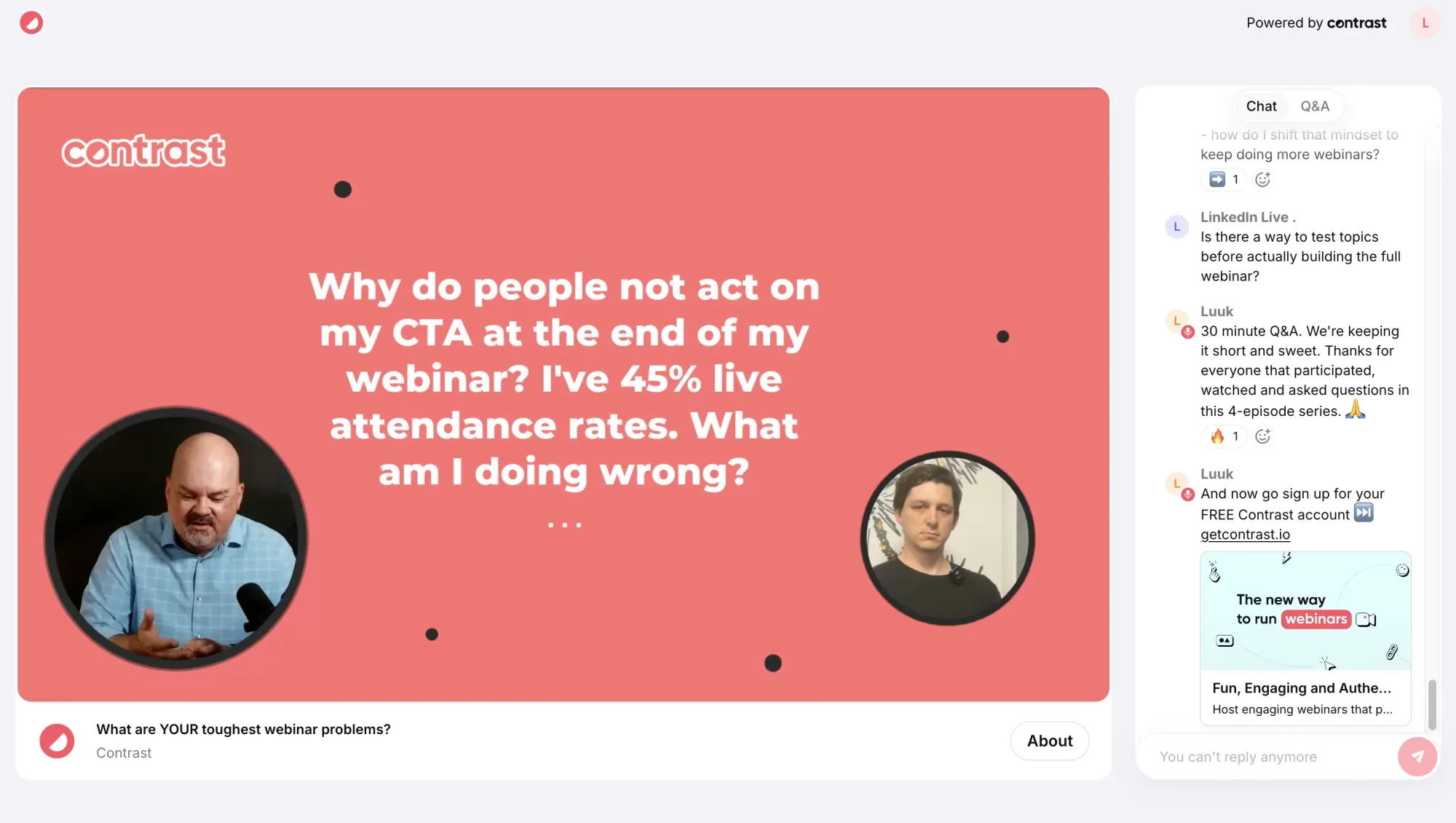
The sessions that fall apart typically do so for the same reason: the moderator announces a hard transition, puts up a "Q&A slide" and spends the final 10 minutes reading whoever asked or typed first. This signals the session is over before it actually is. The energy built over 45 minutes collapses in two.
Don't do this. Here's what you should do instead:
Skip the transition announcement entirely
Move directly from your last forward-looking question into audience questions without signaling a shift. "We've got some great questions coming in — let me bring one on screen now." The guest stays active, the conversation keeps moving, the audience stays engaged.
Filter for universal relevance
Answering in the order questions arrived means you're responding to whoever typed fastest, not whoever asked something the whole room cares about. Skip narrow questions. Skip anything already covered. Skip questions that are clearly from competitors or vendors with an agenda. The moderator picks the questions that resonate with the full audience — not the three people who want their specific edge case solved on camera.
Bring questions on screen (virtual only)
When audience questions appear as overlays inside the video, rather than in a side tab the moderator reads silently from, they become a shared moment rather than an interruption. The question is visible to everyone. The dynamic changes. In Contrast, questions appear this way by default, and questions receive 46% higher engagement and 32% more responses compared to tab-based Q&A. Each exchange also becomes a clippable moment in the replay automatically.
Blend pre-submitted with live questions
Ask for questions at registration ("what would you most like to ask our guest?") and early in the session. Pre-submitted questions are almost always higher quality than ones typed in real time under pressure. Use them early to set the bar: live questions tend to get better once the audience sees what good ones look like.
Three things to do before the event
Send three questions to the guest in advance
Not the full list, just three. Ask: what would make this conversation memorable for you, which topics should we avoid, and what's a question you wish someone would ask you about this topic? This last question reliably surfaces the session's best moment.
Build arcs instead of lists
Map your questions against the seven stages above. Know at any point in the conversation which stage you're in. If you're 25 minutes in and still in background and context, you've stalled, the arc gives you the map to course-correct without it being visible to the audience.
Flag your challenge questions
Let the guest know in advance that you'll push back at least twice. Frame it as an invitation: "I'm going to play devil's advocate on [position] — just so you know it's coming." Guests perform better when they're prepared to defend their thinking. The exchange is sharper. The audience gets more value.
One more tactic worth noting: yes/no questions can be surprisingly effective in fireside chats. Guests feel compelled to fill the silence with context and caveats, often revealing more than an open-ended question would have prompted.
Hosting fireside chats as virtual events?
Contrast's on-screen Q&A surfaces audience questions inside the video stream, turning each exchange into a visual moment and an automatic replay clip. Every question is automatically synced to your CRM, so that your sales team can follow up appropriately.

FAQ
What are good questions to ask at a fireside chat?
Good fireside chat questions create tension rather than biography. Start with a question that positions the guest against something the audience currently believes — not "tell us about yourself." The most useful questions are specific enough to be answerable from direct experience, but broad enough that the whole audience cares about the answer. Avoid anything that invites a five-minute origin story at the opening and anything that can be answered with a vague principle instead of a concrete example.
How many questions should you prepare for a fireside chat?
Prepare 15–20 questions for a 45–60 minute fireside chat, organized by the arc above. You'll rarely use all of them, plan to actually use around 10–12, with room for the conversation to develop in its own direction. The extras exist so you're never scrambling. Budget roughly one question per four minutes of planned moderator time, with more time given to insight and challenge questions than to wrap-up.
How do you moderate a fireside chat?
The moderator's role is to be the audience's proxy, asking the questions attendees are thinking but haven't articulated, pushing back when the guest gets vague and keeping the conversation on the arc that serves the audience rather than flattering the guest. Introduce the guest briefly, set the opening tension with your first question, and build toward action-oriented questions in the final third. The underlying skills for moderating a panel discussion transfer directly to this format, with the main difference being that every question goes to one person — which makes the challenge questions land harder.
What's the difference between a fireside chat and a panel discussion?
A fireside chat is one moderator and one guest. A panel involves multiple guests discussing a topic together, with the moderator playing traffic controller rather than lead interviewer. Fireside chats create depth on a single perspective; panels create breadth across multiple viewpoints. The question design is different too — in a fireside chat you're building a single sustained arc, while in a panel you're balancing multiple voices. For the full breakdown of formats, the fireside chat vs. panel comparison covers the differences in structure, participant dynamics and audience role.
How long should a virtual fireside chat run?
45–60 minutes is the standard for a B2B virtual fireside chat. Under 30 minutes doesn't give the arc time to develop, the conversation ends just as the insight gets interesting. Over 60 minutes requires either an unusually compelling guest or a segmented format with clear breaks. Plan 35–40 minutes of moderated questions, 10–15 minutes of audience Q&A, and 5 minutes for wrap-up and CTA.
How do you handle audience questions at a fireside chat?
Don't signal the transition with a Q&A slide, it gives the audience permission to mentally check out. Move directly from your last forward-looking question into audience Q&A without announcing the shift. Filter for questions that resonate with the full room rather than the person who typed fastest. Aim for 10–15 minutes of audience Q&A at the end of a 45–60 minute session, and bring questions on screen rather than reading them from a list where possible, it keeps the energy up and makes each exchange feel like part of the conversation.