Most B2B teams run events. Yet, very few run them as a well thought-out marketing plan that drives real change.
They pick a date, book a speaker, set up a registration page, send a couple of emails, and wait. When registration numbers come in low, the usual response is to push harder in the final week. When attendance is poor, they blame the timing. When follow-up generates nothing, they question whether events are worth running at all.
Ready to run your next big event?
The problem isn't the event. It's the absence of a marketing plan.
An event marketing plan isn't a logistics checklist. It's a campaign brief — audience-specific, goal-specific, with a defined promotion timeline, a channel mix, and a post-event sequence that starts before the live date. The teams consistently generating pipeline from events aren't doing something radically different in execution. They're treating every event as a marketing campaign, not a one-off content production.
This guide walks through how to build that plan, with a template you can apply to your next event immediately. It focuses on webinars, not because other formats don't matter, but because webinars are the format B2B marketing teams run most often, at the highest frequency, and with the most measurable ROI.
💡
📊 This article draws on Contrast's 2026 research — insights from 524 B2B marketers and analysis of over 1M webinar registrants. For the full dataset, see the 2026 Webinar Stats Report.
Why the plan matters more than the event itself
Events are the highest-ROI channel most B2B marketing teams underinvest in strategically. 52% of B2B marketers say events are responsible for at least half of their company's closed-won deals. Our own research backs this up: 80% of B2B marketers say webinars are among their most effective lead generation tactics — and 64% now use them as part of their core content strategy.
But ROI from events isn't automatic. The common failure is treating the event itself as the deliverable. Once the session ends, the team moves on. The follow-up is an afterthought. The registrants who didn't show up get nothing. The engagement data sits unused in a platform nobody checks.
The plan exists to prevent this. It forces clarity upfront — who are we reaching, what do we want them to do, how do we measure success — and it creates the structure that turns attendance into pipeline.
For B2B teams, webinars are the core event format worth building a plan around. They're scalable, they generate rich behavioral data, and they work at every funnel stage. The framework below is built with webinars as the primary format, though it applies to any virtual or hybrid event. You may want to adapt timelines suggested in this article for larger, or in-person events.
The four-stage event marketing plan
A B2B event marketing plan runs in four stages: foundation, promotion, execution, and post-event. Each stage has clear inputs and outputs. Running them in sequence — and not jumping straight to promotion — is what separates campaigns that generate pipeline from those that generate registrations and nothing else.
Stage 1: Foundation
Before a single promotion asset is built, three things need to be locked.
Define the goal
Not all events have the same purpose. A webinar designed to generate net-new pipeline looks different from one built to accelerate deals already in the funnel. A thought leadership session serves a different purpose than a product launch.
Naming the goal explicitly determines the CTA, the follow-up sequence, and what success looks like. Common B2B event goals:
Top of funnel: net-new lead generation from cold or warm audiences
Mid-funnel: pipeline acceleration — existing prospects who need a nudge
Bottom of funnel: customer retention, expansion, or onboarding
Brand authority: long-term category positioning
Pick one primary goal per event. Everything else flows from it.
Define the audience
Audience definition is more specific than "our ICP." For any given event, the relevant questions are: which segment of the ICP is most likely to care about this topic? What job titles need to be in the room for the event to hit its goal? Is this a cold audience reached through paid or organic, or a warm audience of existing contacts and past registrants?
The answers determine which lists get promoted to, which channels get prioritized, and how copy gets framed.
Set KPIs before promotion starts
The math for webinar events is straightforward: 61% of registrants will watch live or on-demand. If you need 50 engaged viewers to hit your pipeline goal, you need roughly 80 registrations minimum. Work backwards from the goal and set numeric targets before promotion begins.
Target conversion rate (attendees who take the primary CTA)
Pipeline value generated (for sales-aligned events)
Stage 2: Promotion
The promotion stage is where most teams make their biggest mistakes. They compress the timeline, rely too heavily on one channel, and send the same message to everyone regardless of where they are in the buyer journey.
Set the promotion window
Four weeks is the minimum promotion window. Start building assets 6–7 weeks out. The counter-intuitive reality: 59% of registrants sign up in the 7 days before an event, so you'll see the bulk of registrations late — but the early promotion builds the awareness that makes those late sign-ups happen. Compressing to two weeks consistently hurts final numbers.
💡
For larger, and especially hybrid or in-person events we recommend to take a longer timeline.
Week out
What to complete
6–7
Lock goal, audience, speaker, topic. Brief design and copy.
5
Registration page live. Both email tracks built. Social assets created.
4
First invitation email send. LinkedIn launch.
2
Second invitation email send. LinkedIn amplification.
1
7-day reminder to confirmed registrants.
3 days
Pre-event reminder.
Day of
Morning send. Re-send to non-openers.
Post-event
Segmented follow-up starts within 24 hours.
Email is your primary channel
Email drives 57% of webinar registrations — more than any other channel. Your email strategy should run two parallel tracks:
Invitation track: for contacts who haven't registered yet. Ends when they register.
Reminder track: for confirmed registrants. Runs at 7 days, 1 day, and 15 minutes before the event.
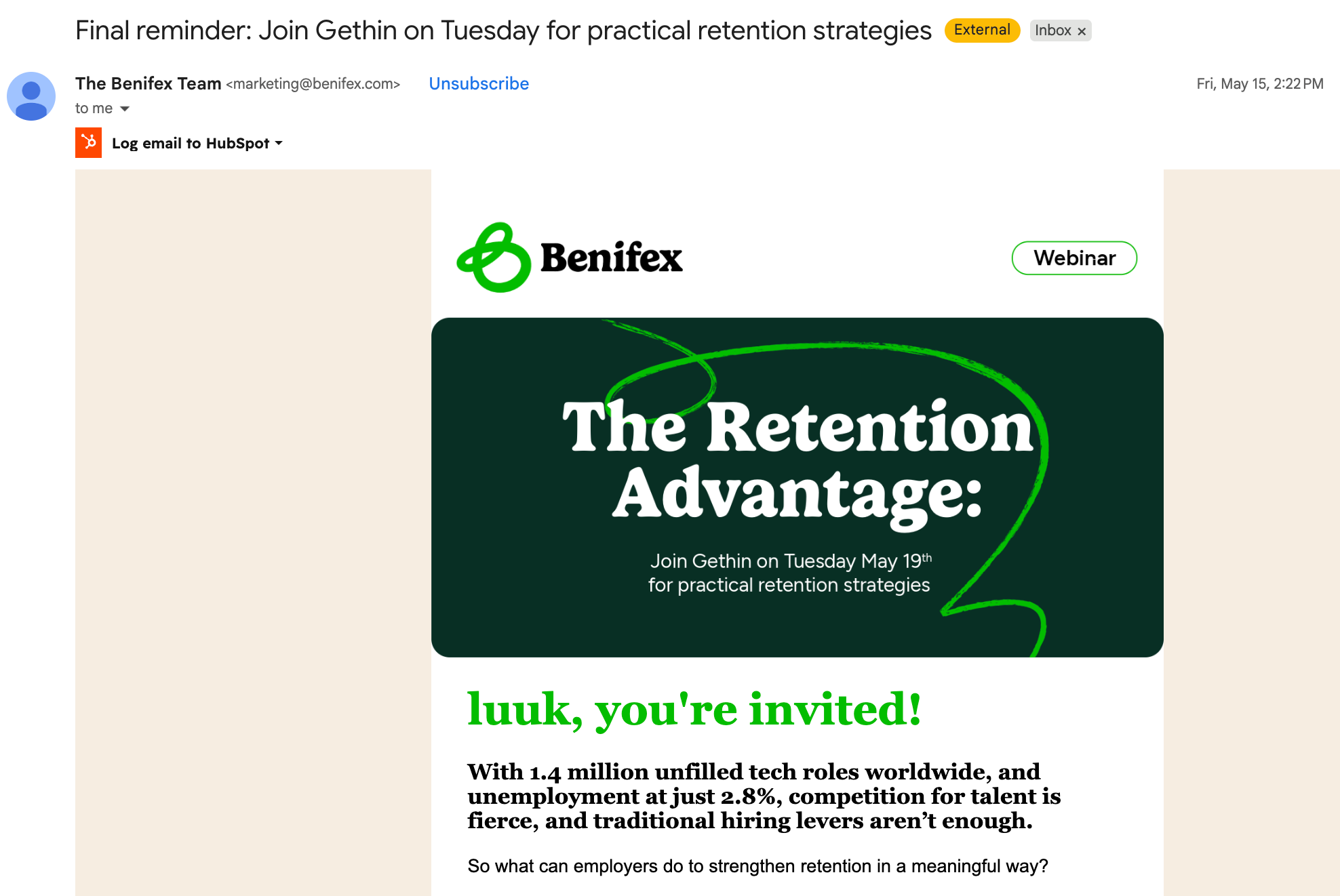
Final reminder emails work!
This separation matters. Once someone registers, they should stop receiving invitation emails immediately. Sending a "register now" email to someone already on the attendee list is the kind of detail that erodes trust with your best leads.
Send on Tuesday where possible. Based on our platform data, Tuesday consistently outperforms other days for both invitation emails and reminder sends. Lead with the value, not the format: "Learn how to cut no-show rates by 30%" outperforms "Join our webinar on attendance optimization."
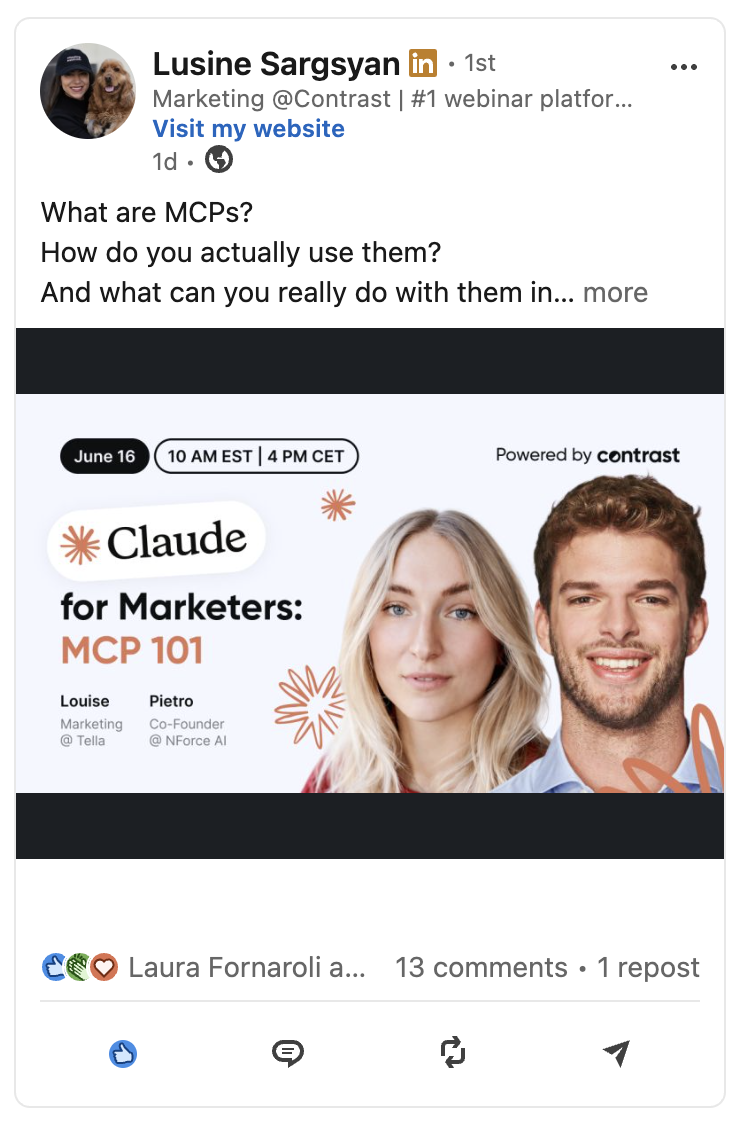
For B2B events, LinkedIn is the most effective social channel. The tactics that move the needle: posts from individual speakers (not the company page alone), short video clips from pre-event conversations with the speaker, and direct outreach by the sales team to relevant contacts in their networks. LinkedIn's own B2B research consistently shows that peer-to-peer amplification outperforms brand broadcasting — and webinars are no exception. Company page posts announcing the event rarely drive significant registrations on their own.
Promote your event on LinkedIn
Build a registration page that converts
A well-structured registration page converts at 30–40% for warm traffic. The elements that make the difference: a clear headline that leads with the outcome, a short description that answers "why should I give up an hour for this," visible speaker credentials, a single CTA, and social proof — attendee count or company logos can lift conversion by 10–20%.
A registration page with a single clear CTA outperforms one with multiple options by up to 40%. Remove everything that isn't directly relevant to the decision to register.
The day of the event is not the end of the campaign, trust us, you're just getting started.
Run your reminder sequence to the end
Your automated reminders should fire at 7 days, 1 day, and 15 minutes before the event. The calendar invite — sent automatically on registration — is the single biggest lever for show-up rates. Teams that skip it consistently see attendance rates 10–15 points lower than those that don't.
Improve attendance rates with automatically set up reminders on Contrast
Treat engagement as your lead qualification layer
Polls, Q&As, and on-screen CTAs aren't optional extras. They're how you differentiate between someone who passively watched and someone who is actively interested. An attendee who answers a poll is signaling engagement. An attendee who clicks a CTA is signaling intent. Both data points feed directly into your post-event segmentation.
If you're not capturing behavioral data during the session, you're missing the best qualification signal in your marketing calendar.
Leave with complete data
By the time the session ends, you should have: who attended live and for how long, which polls they answered, which CTAs they clicked, which questions they asked. This isn't just analytics — it's your segmentation input for Stage 4.
Stage 4: Post-event
The post-event stage is where most event marketing fails. One "thanks for joining, here's the recording" email sent to everyone wastes the most valuable moment in your program.
Segment every post-event follow-up into three buckets:
No-shows (registered, didn't attend)
These are warm leads. They showed intent by registering. Send the recording within 24 hours using copy specific to people who missed the event — not the same email as attendees. Reference what they'll learn from the recording, not what they missed.
Passive attendees (attended, low engagement)
Attended live but didn't interact — under 50% watch time, no polls answered, no CTAs clicked. Route to a nurture sequence. Don't send to sales yet.
Highly engaged (attended, high engagement)
High watch time, answered polls, asked questions, clicked CTAs. Follow up within 24 hours. Make the message specific to what they did. If they clicked the demo CTA, follow up with a demo offer. If they asked a relevant question in Q&A, reference it.
After the initial follow-up sequence, repurpose the event. The recording becomes an on-demand asset. Short clips feed social and email nurture. A single webinar done well can generate 10–20 additional content pieces — see our guide to repurposing webinar content.
💡
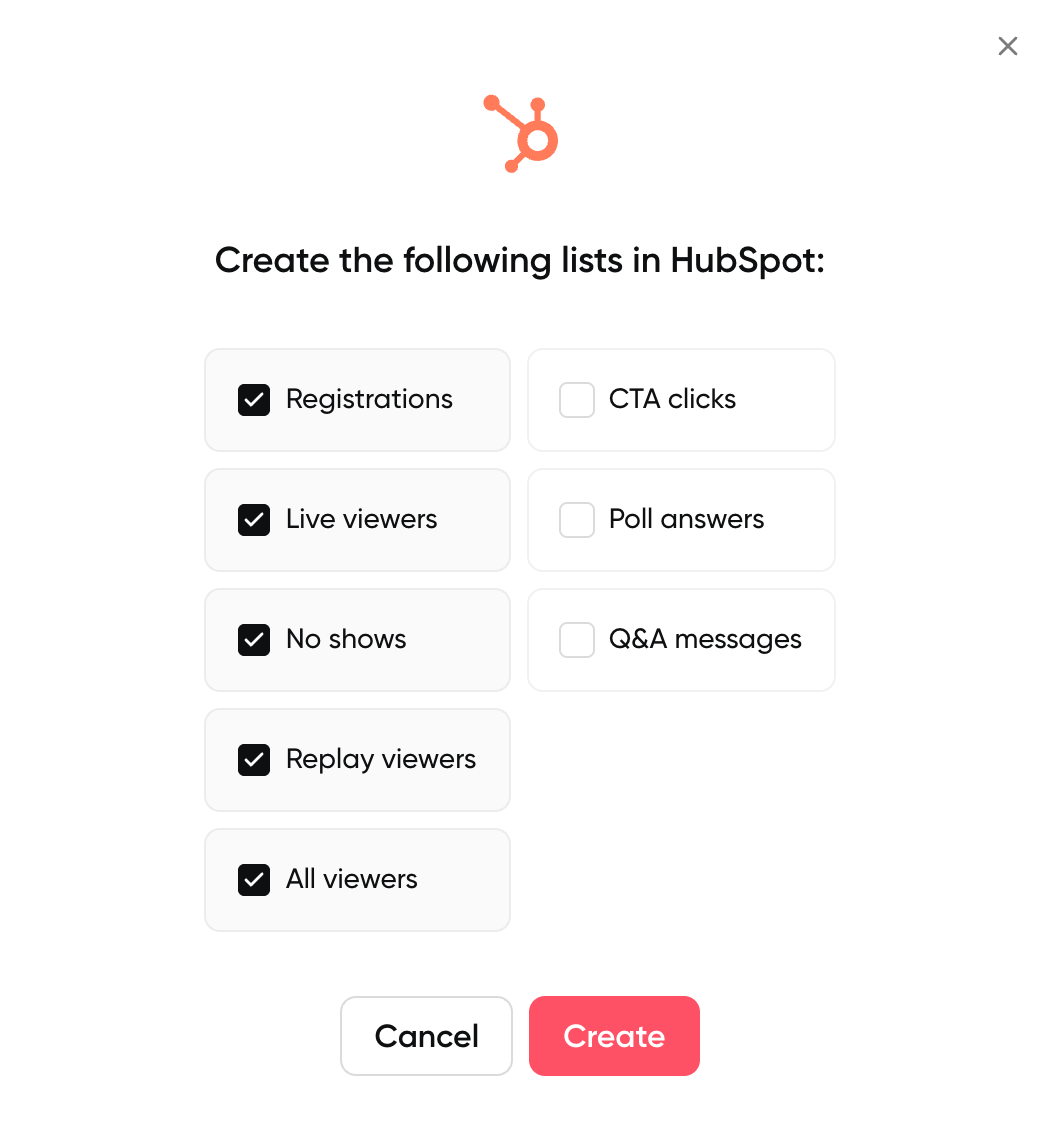
HubSpot users: registrations, watch time, poll answers, CTA clicks, and Q&A questions sync automatically to each contact record. One-click lists let you create your three follow-up segments instantly, before the post-event email is even written. See how the HubSpot integration works →
Event marketing plan template
Use this brief for every event you run. Fill it in before any promotion begins.
💡
If you run hybrid or in-person events, we recommend to take more time to plan your event.
Event brief
Field
Your input
Event name
Date and time (with timezone)
Format
Webinar / virtual / hybrid
Primary goal
Lead gen / pipeline acceleration / retention / education
Target audience
Job title, company size, industry, funnel stage
Target registrations
Target attendance rate
Primary CTA
(What you want attendees to do during or after the session)
Speaker(s)
Key message
(One sentence: what will attendees know or be able to do after?)
Promotion timeline
Week
Task
Owner
Status
W-6
Lock topic, speaker, date
W-5
Registration page live
W-5
Email sequences built (invitation + reminder)
W-5
Social assets created
W-4
First invitation email
W-4
LinkedIn organic launch
W-2
Second invitation email
W-2
LinkedIn amplification / paid if budget
W-1
7-day reminder to registrants
W-0
Day-before reminder
Day of
Morning reminder + re-send to non-openers
+1 day
Segmented post-event follow-up
Post-event segmentation
Segment
Criteria
Action
No-show
Registered, 0% attendance
Recording email (separate copy) within 24h
Passive attendee
<50% watch time, no interactions
Nurture sequence
Highly engaged
>50% watch time, answered poll, clicked CTA, or asked a question
Sales-aligned follow-up within 24h
Where B2B event plans most commonly break down
Even well-structured plans fail at two predictable points:
The segmentation problem
Most teams set up the foundation and promotion stages well. The plan falls apart post-event. The recording goes to everyone on one email, the sales team gets a raw attendee list with no context, and a week later no one has followed up with anyone.
Create lists you can use to segment you audience
The fix is structural: before the event, decide exactly what "a good lead from this event" looks like and set up the routing. If that conversation doesn't happen before the event, it won't happen after it.
Measuring attendance instead of pipeline
Registration counts and live attendance numbers are easy to report. They're also the metrics that least reliably predict whether an event generated value. According to Vendelux's analysis of B2B event marketing data, 86% of B2B organizations report positive event ROI — yet most marketing teams still report to leadership on headcount metrics rather than pipeline contribution.
The number that matters is what happened downstream: how many attendees entered or advanced through a sales opportunity, what pipeline value was generated per event. Without your webinar platform connected to your CRM, this measurement is almost impossible to do at scale. Tracking webinar analytics through the full funnel — not just within the platform — is what turns event reporting from a vanity slide into a budget justification.
Focus on what's important with Contrast
Event, and webinar planning is difficult and takes up time. Most marketers find that their webinar platform adds to this, making it more difficult to run successful events. Except for the marketers who run their events on Contrast webinars.
They find that Contrast is easy to use, thanks to its modern design. It's custom built for marketers who run B2B and has many features, such as automatic calendar invites, email sequences and modern – and branded registration pages.
Run modern webinars
Save hours of frustration with the right webinar platform
What should a B2B event marketing plan include? A B2B event marketing plan should include a clearly defined goal, a target audience and ICP segment, a promotion timeline with a minimum four-week window, a channel plan led by email, a post-event follow-up strategy segmented by attendance and engagement, and KPIs set before promotion begins. The template in this guide covers all six components.
How far in advance should you promote a B2B event? Start building assets 6–7 weeks out and launch promotion 4–5 weeks before the event. Most registrations (59%) arrive in the final week, but early promotion creates the awareness that makes those late sign-ups possible. Compressing to two weeks consistently reduces final registration totals.
What's the most effective channel for promoting a B2B webinar? Email is the single most effective channel, driving 57% of registrations. LinkedIn is the most effective social channel for B2B audiences — speaker-led posts outperform company page posts by a significant margin. Paid social can extend reach but rarely drives meaningful registrations on its own.
How do you measure event marketing ROI? The clearest measure is pipeline value generated: how many registrants or attendees entered or advanced through a sales opportunity. To track this accurately, your webinar platform needs to sync attendance and engagement data to your CRM. Registration count and attendance rate are leading indicators, but they shouldn't be the primary metric you report to leadership.
What's a reasonable attendance rate for a B2B webinar?Industry benchmarks sit at 35–45% for a typical webinar. The upper end — 45–50% — is consistently achieved when calendar invites are sent on registration and a three-email reminder sequence runs at 7 days, 1 day, and 15 minutes before the event. Attendance rates below 30% usually indicate a problem with the reminder sequence, not the content or the audience.
Should no-shows receive the same follow-up as attendees? No. No-shows registered and showed intent — that matters. But sending them the attendee follow-up email assumes they watched the presentation, which they didn't. Send the recording in a separate email that acknowledges they missed it and explains what they'll get from watching. Treating them the same as attendees damages the credibility of both messages.