
Most event marketing fails before the event starts.
Not because the topic is wrong or the speaker is weak. It fails because the event is treated as a logistics task, not a marketing campaign.
Teams pick a date, build a registration page, send a few emails, and wait. When registrations are low, they push harder in the final week. When attendance is poor, they blame the timing.
The problem is the absence of a real strategy.
This guide covers the event marketing strategies that drive registrations, attendance, and pipeline. Whether you run webinars, in-person conferences, or hybrid events, the strategies below apply.
Ready to build your execution plan? Jump straight to our B2B Event Marketing Plan: Template & Complete Guide →
What is Event Marketing?
Event marketing is the practice of promoting your brand, product, or service through live experiences. Those experiences can take many forms:
- In-person events — conferences, trade shows, field events, product launches, and meetups
- Virtual events — webinars, online summits, and digital product demos
- Hybrid events — a combination of live and virtual, where some attendees join in person and others join remotely
The goal is always the same: create a direct connection with your audience that other marketing channels can't replicate.
Event marketing is used at every stage of the funnel. At the top, it generates awareness and new leads. In the middle, it accelerates deals that are already in progress. At the bottom, it supports customer retention and expansion.
Why Event Marketing Works
Event marketing is one of the highest-ROI channels in B2B marketing. The data backs this up.
91% of B2B professionals say webinars are their preferred content format. More than half engage with them at least once a week. Webinars rank as the second most effective B2B content channel overall, just behind in-person events.
The leads are high quality too. 73% of B2B marketers say events generate their best leads. That makes sense. Attendees self-select based on topic interest, invest their time, and engage directly with your brand. That level of commitment signals real buying intent.
And events convert. Nearly 63% of webinar attendees have made a purchase decision after attending a session.
The problem is that most teams underinvest in the strategy behind their events. The event itself is not the hard part. Getting the right people there, engaging them effectively, and following up in a way that creates pipeline is where most teams fall short.
The strategies below cover all of it.

Run Your Next Virtual Event with Contrast
Start for free up to 30 registrants. No credit card needed.
Start for free7 Event Marketing Strategies That Actually Work
1. Build Your Promotion Around Email
Email is the single most effective channel for event promotion. It drives 57% of webinar registrations, more than any other channel.
The mistake most teams make is treating email as one touchpoint. Send an invite, send a reminder, done. A proper email strategy runs two parallel tracks.
The first is an invitation track for contacts who haven't registered yet. The second is a reminder track for people who have. Once someone registers, they should stop receiving invitation emails immediately. Sending a "register now" email to someone already signed up damages trust with your best leads.
Timing matters too. Tuesday consistently outperforms other days for invitation emails. Lead with the value, not the format. "Learn how to cut no-show rates by 30%" outperforms "Join our webinar on attendance optimization" every time.
For a full breakdown of how to structure your email sequence, see our webinar email sequence guide.
2. Use Social Media to Build Demand, Not Just Announce
94% of B2B marketers use social media to promote their events. But most use it to announce, not to build demand.
There is a difference. An announcement says "this is happening, come if you want." Building demand makes people feel they would miss something if they didn't show up.
Every post before your event should do one of three things: show the topic matters, prove the speaker knows what they're talking about, or make the format feel worth someone's time.
For B2B events, LinkedIn is the most important platform. A post from a speaker's personal profile reaches 20-40% of their followers. A post from a company page reaches around 3-5%. Get your speakers posting. Give them suggested copy and graphics. Remove as much friction as possible.
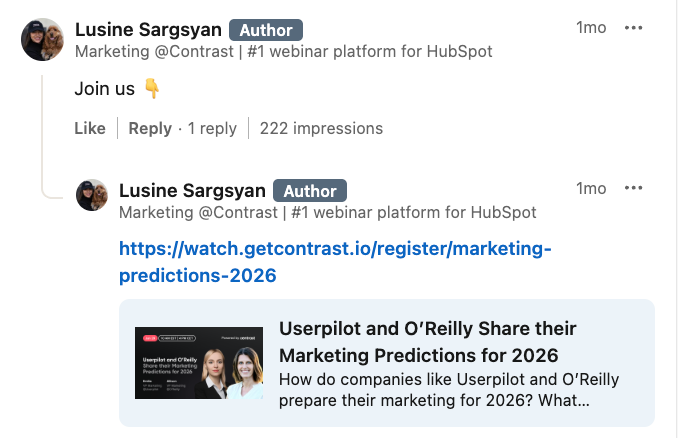
For in-person and hybrid events the same principle applies. Speaker-led posts, behind-the-scenes content, and early attendee social proof consistently outperform company announcements.
For a full platform-by-platform breakdown of what to post and when, see our guide on how to promote your event on social media.
3. Choose the Right Event Format
Not every event needs to be in person. Not every event works better online. The format you choose affects your reach, your costs, and who can actually attend.
There are three formats to consider:
- In-person events — conferences, trade shows, field events, and product launches. Best for building relationships and creating memorable experiences. Higher cost, higher effort, geographically limited.
- Virtual events — webinars, online conferences, and digital product demos. Scalable, cost-effective, and accessible to a global audience. Every interaction is trackable.
- Hybrid events — a combination of both. Attendees can join in person or remotely. Hybrid events remove geographical barriers without losing the energy of a live gathering.
The right choice depends on your goal and your audience. If you need to reach a large or global audience cost-effectively, virtual is hard to beat. If relationship-building and face-to-face interaction matter more, in-person is worth the investment. Hybrid works well when you want both but requires more planning and a stronger tech setup.
One thing that applies across all three formats: the marketing fundamentals are the same. You still need a clear audience, a promotion timeline, and a post-event follow-up plan.
For a deeper look at hybrid events, see our complete hybrid events guide. For virtual conferences specifically, see how to host a virtual conference.
4. Make Your Events Interactive
Most events lose their audience somewhere in the middle. Not because the content is bad, but because watching a presentation for 60 minutes without being involved is hard for anyone.
This applies whether you're running a virtual webinar, a conference, or a hybrid event. The format changes but the principle doesn't. People engage more when they feel involved, not just spoken at.
Interactive events perform better. Attendees who interact early are significantly more likely to participate in Q&A, click your CTA, and convert after the event. Engagement is also your best lead qualification signal. An attendee who answers a poll is showing interest. An attendee who clicks a CTA is showing intent.
A few ways to build interaction into your event:
- Live polls — work for both virtual and in-person audiences. 46% of webinars use them, but the ones that do see stronger engagement throughout the session
- Q&A sessions — prepare two or three seed questions in advance in case the session opens to silence. Good Q&A turns a presentation into a conversation
- Ice-breakers — ask where people are joining from or what brought them to the topic. Works just as well in a conference room as it does online
- On-screen CTAs — for virtual events, one clear CTA communicated on a slide, in the chat, and verbally. For in-person, make sure it's visible in the room and easy to act on
- Breakout sessions — for hybrid and in-person events, small group discussions create the kind of connection that a main stage can't
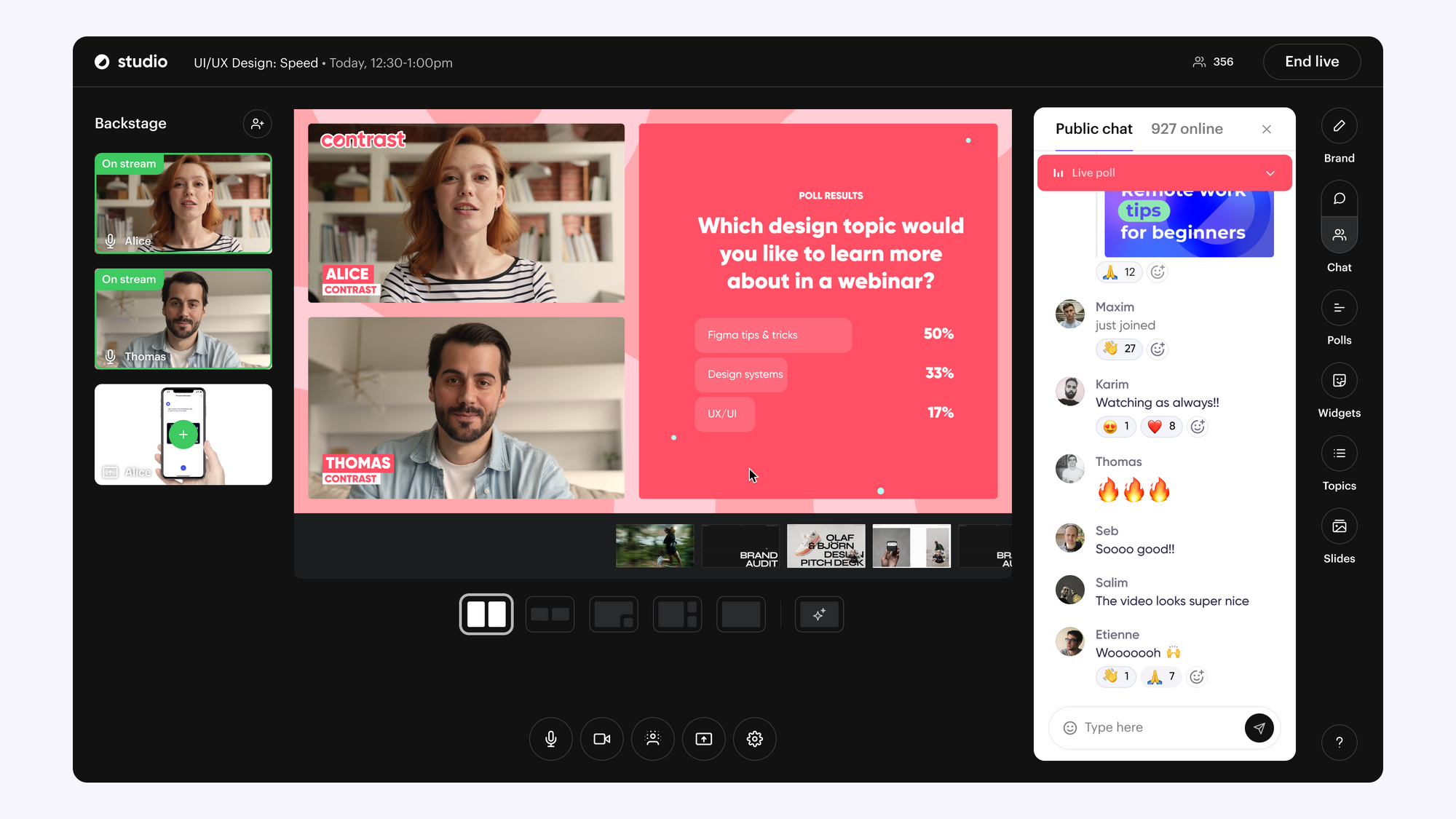
For a full breakdown of how to run engagement from start to finish, see our guide on how to host a webinar.
5. Use Data to Qualify and Follow Up
Most event marketing ROI is lost after the event ends. Teams send one "thanks for joining" email to everyone, hand a raw attendee list to sales, and move on. The data collected during the event goes unused.
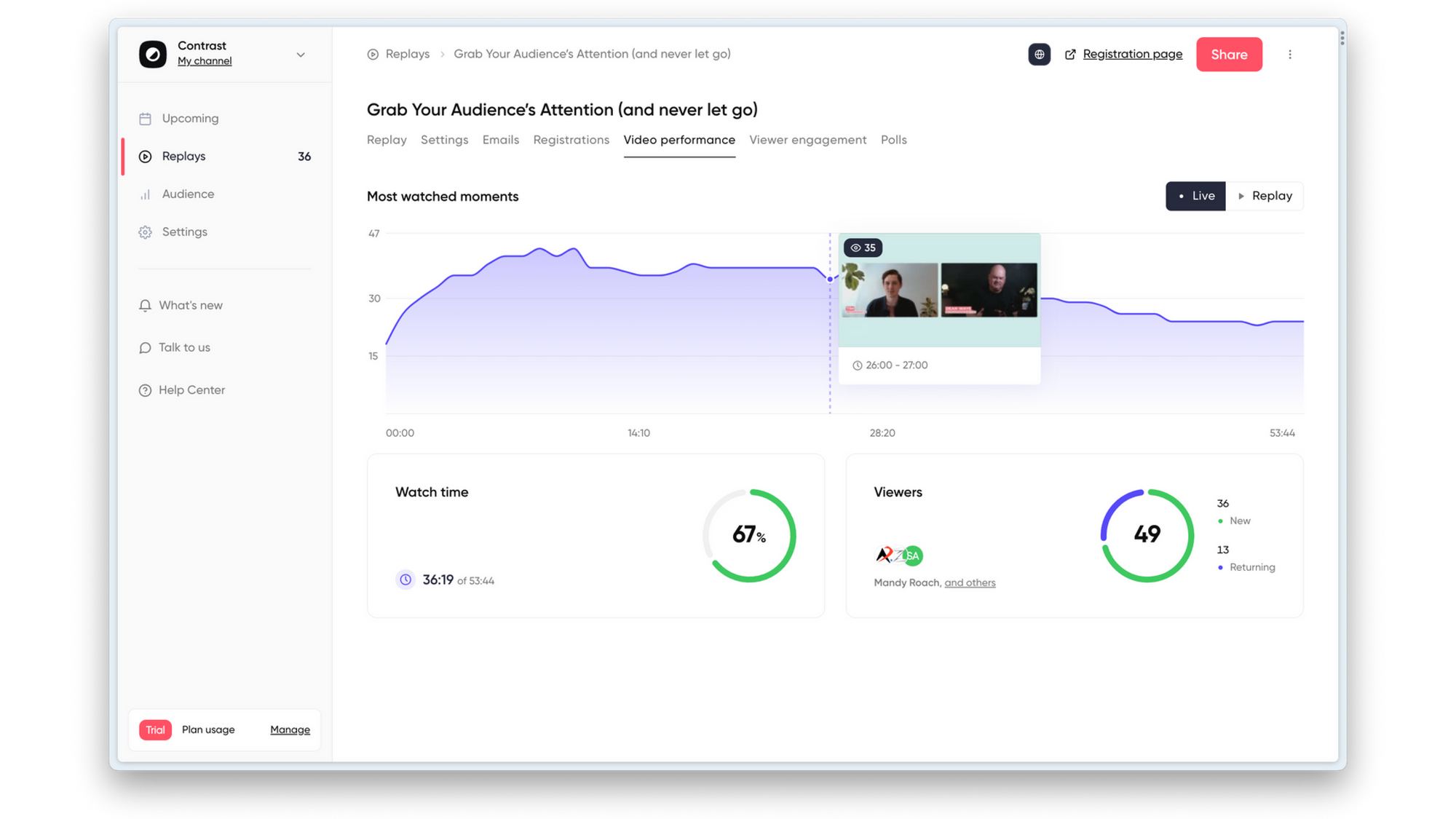
The attendees who engaged during your event are not the same as those who passively watched. For virtual and hybrid events, watch time, poll responses, questions asked, and CTA clicks are all intent signals. For in-person events, session attendance, booth visits, and questions asked serve the same purpose. Treating all attendees the same wastes those signals.
A simple way to segment your post-event follow-up:
- No-shows — they registered and showed intent. Send the recording or event recap within 24 hours with copy specific to people who missed it
- Passive attendees — attended but low engagement. Route to a nurture sequence
- Highly engaged — high watch time or active participation, answered polls, clicked CTAs, visited booths. Follow up within 24 hours with a message specific to what they did
The first follow-up should always go out within 24 hours. This is when the event is still fresh and your brand is top of mind.
The teams that capture and act on engagement data consistently outperform those that treat all attendees the same regardless of event format.
For a full breakdown of how to structure your post-event emails, see our guides on webinar follow-up emails and webinar analytics.
6. Repurpose Your Event Content
Most teams treat an event as a one-time moment. It runs, it ends, they move on. That's a significant amount of value left on the table.
Every event, virtual, hybrid, or in-person, produces content that can keep working for weeks after it ends. A webinar gives you a recording, a transcript, a Q&A session, and poll results. An in-person conference gives you session recordings, speaker talks, audience questions, and stage moments. The raw material is already there.
According to Contrast's own research, 52% of marketing professionals incorporate webinars into their content strategy but only around 20% of that content gets repurposed. That's a lot of wasted output.
A few ways to get more from every event:
- Short clips — pull 30-90 second highlights from recordings and post on LinkedIn, Instagram, or YouTube. Works for virtual and in-person sessions alike
- Blog posts — turn the transcript or key talking points into a written article. One 60-minute session can produce multiple posts
- FAQ pages — every question from your Q&A is a real search query. Format them as a proper FAQ page and they become findable content long after the event
- Newsletter content — pick one strong insight from the event and write it up as a standalone newsletter post
- Social graphics — pull the best stats, quotes, or poll results and turn them into visuals for social media
- On-demand replay — make recordings available after the event. Over 50% of webinar views happen after the live session ends
The teams that build a repeatable repurposing process get 10 or more content pieces from a single event. That's a significant return on content you already created.
For a full breakdown of how to repurpose event content, see our guide on repurposing webinar content.
7. Align Your Events to Pipeline Goals
Most event marketing is measured by registrations and attendance. Those numbers are easy to report but they don't tell you whether the event actually generated business value.
The teams that consistently get budget approved for events are the ones that connect event activity to pipeline. That means deciding before the event what a successful outcome looks like in business terms, not just in headcount.
Events serve different purposes depending on where your audience is in the buying process:
- Top of funnel — generating net-new leads and building brand awareness with cold or warm audiences
- Mid funnel — accelerating deals already in progress with prospects who need more information or a reason to move forward
- Bottom of funnel — supporting customer retention, expansion, or onboarding with existing customers
The format and content of your event should match the goal. A thought leadership webinar designed to generate new leads looks very different from a product deep-dive designed to move a deal forward.
Setting the goal upfront also determines what you measure. Registration count is a leading indicator. What actually matters is how many attendees entered or advanced through a sales opportunity and what pipeline value was generated.
52% of B2B marketers say events are responsible for at least half of their company's closed-won deals. But that result doesn't happen without intentional planning upfront.
If you're ready to build a full execution plan around your next event, see our B2B Event Marketing Plan: Template and Complete Guide.
Common Challenges in Event Marketing and How to Overcome Them
Budget Constraints
Events can be expensive. From securing a venue to providing food and beverages, costs can quickly escalate and stretch your marketing budget thin. This doesn't even include other costs such as promotion and tech setup.
However, with careful planning and the right strategic approach, it's possible to host a successful event without blowing your marketing budget. Focus on what matters - the value you're providing to your attendees. Concentrate resources on speakers or workshops that reinforce your brand value and generate meaningful interactions.
- Consider sponsorship or partnerships: Team up with relevant businesses or influencers to share costs and boost visibility.
- Leverage digital platforms: Considering setting up an online webinar or hybrid event significantly reduce event costs.
- Plan ahead: Early planning allows for better deals and bargains, saving costs in the long run.
When running a virtual or hybrid event, consider repurposing your content. This helps you get more bang for your buck. You can get 10-20 additional pieces of content from every hour of your event - this can feed your marketing team for weeks.
Low Registrations
Low registrations are the most common event marketing problem. In most cases the issue isn't the topic or the speaker. It's the promotion.
A few things that directly impact registration numbers:
- Starting promotion too late. Four weeks is the minimum window. Most teams compress to two and wonder why numbers are low
- Relying too much on one channel. Email drives the most registrations but social, partners, and communities all add up
- A registration page that doesn't convert. A clear headline, visible speaker credentials, and a single CTA can make a significant difference. Registration pages on Contrast convert at up to 59%
- Poor timing. Thursday webinars consistently attract the most registrants. 24% of all registrations happen on Tuesdays, making it the best day to send invitation emails
Measuring Event Success
Event evaluation can be tricky. Determining the success or failure of an event isn't only about the number of attendees or leads generated.
Develop clear measurable objectives at the planning stage, such as increased brand awareness, networking, or sales leads. Having these targets in place will help you choose the right data to track.
- Surveys: Use post-event surveys for actionable feedback from attendees
- Social media and website analytics: Brand your events and monitor your online engagement levels pre and post-event to track brand visibility
- CRM tools: Monitor lead conversions and sales impact post event
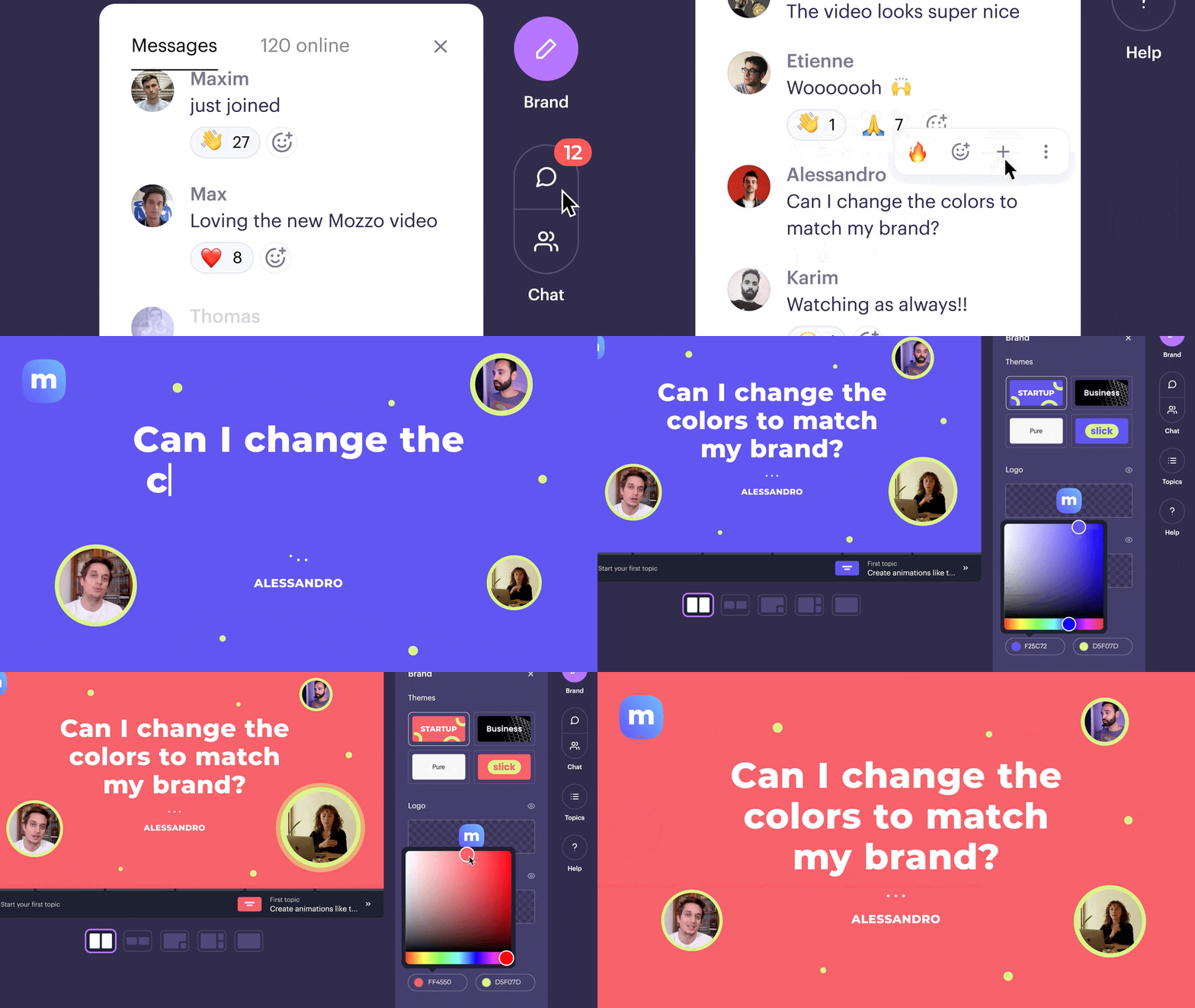
Through understanding and addressing these challenges, businesses can better equip themselves for more successful, effective event marketing.
For a full breakdown of what to track and how, see our guide on webinar analytics.
Case Studies of Successful Event Marketing Strategies
- Real-world examples of highly-effective event marketing strategies
- Understand the strategies behind the success and glean insights for your own campaigns
- Results achieved by these strategies to prove their efficiency
Case Study 1
Reaching new heights with multimedia integration. An event management company once coordinated an extensive multimedia campaign for a major tech conference. All event elements - from speaker promotions, invitation emails, interactive app features, to post-event wrap-up campaigns - were utilized for cohesive brand consistency.
The results were impressive, with a remarkable 60% increase in event attendance, daily app interactions skyrocketing to 400%, and post-event satisfaction surveys indicated unprecedented attendee engagement (8.9/10 rating compared to 6.4 the previous year).
Engaging attendees before, during, and after the event resulted in prolonged engagement. By applying these practices, your events can potentially experience similar levels of increased attendance and positive attendee response.
Case Study 2
Transforming webinar invitations and communication with strategic partnerships. A well-known drinks brand partnered with a popular music festival for a co-branded marketing presentation that remarkably increased attendee immersion.
Through the partnership, the event saw a 35% boost in social media engagement, achieved 80% visitor participation in festival activities, and received extensive PR coverage.
The key takeaway: partnerships can open up opportunities for co-promotion, broadening your reach while creating a unique and memorable event experience.
Case Study 3
Innovating the in-person experience with augmented reality (AR). A leading automaker debuted its latest model at a car show using an AR installation.
The attendees could see the car's features 'come to life,' creating a gripping and immersive experience. This not only drew large crowds but also generated excitement both at the event and online, leading to a 45% increase in social media mentions and a 30% rise in inquiries for that particular model.
The case underlines that implementing technology creates unique, interactive, fun virtual event experiences, setting yours apart from others, and helps drive attendee engagement even after the event concludes.
Frequently Asked Questions
What is event marketing?
Event marketing is the practice of promoting your brand, product, or service through live experiences. Those experiences can be in-person, virtual, or hybrid. The goal is to create direct engagement with your audience that other marketing channels can't replicate.
What are the most effective event marketing strategies?
The most effective strategies are building your promotion around email, using social media to build demand before the event, choosing the right format for your audience, making events interactive, using data to qualify and follow up, repurposing event content, and aligning every event to a specific pipeline goal. The strategy that moves the needle most for most teams is post-event follow-up — it's where the most value gets lost.
How do you market an event effectively?
Start with a clear goal and a defined audience before you build any promotion. Email should be your primary channel. Give yourself at least four weeks of promotion time. Build a registration page that leads with value not format. And have a post-event follow-up plan in place before the event runs.
How far in advance should you promote an event?
At least four weeks for virtual and hybrid events. For larger in-person events, six to eight weeks is more appropriate. Most registrations arrive in the final week but the early promotion builds the awareness that makes those late sign-ups happen. Compressing your promotion window consistently hurts final numbers.
How do you measure event marketing success?
Beyond registration count and attendance rate, the metrics that matter are pipeline influenced, deals advanced, and conversion rate from attendee to next step. To measure these accurately your event platform needs to connect to your CRM. Registration and attendance are useful leading indicators but they shouldn't be what you report to leadership.
What is a good attendance rate for an event?
For virtual and hybrid events, 35-50% of registrants attending live is the industry benchmark. The upper end is consistently achieved by teams that send calendar invites on registration and run a structured reminder sequence. For in-person events attendance rates are typically higher since registrants have made a bigger commitment.
Start With One Strategy
You don't need to implement all eight strategies at once. Most teams that get the best results from event marketing start by getting one thing right, then build from there.
If you're just getting started, focus on email and promotion first. It's the highest-leverage change you can make and it affects every event you run regardless of format.
If you're already running events regularly, the biggest opportunity is usually post-event follow-up. Most teams leave significant pipeline on the table by treating all attendees the same after the event ends.
If you're ready to build a full execution plan around your next event, including promotion timelines, email sequences, and post-event segmentation, see our B2B Event Marketing Plan: Template and Complete Guide.
Looking to run the most engaging virtual events or webinars possible? Check out Contrast for a modern experience your attendees will love.

Try the best virtual event platform now
Start for free up to 30 registrants. No credit card needed.
Start for free